Chevy Equinox Engine Replacement Cost: 2026 Price Guide
Table of Contents
13 ChaptersChevy Equinox Engine Replacement Cost at a Glance
Quick answer: Plan on $2,500 to $8,300 to replace a Chevy Equinox engine with a used unit, $4,500 to $9,500 for a remanufactured one, or $5,500 to $12,000 for a brand-new GM engine, fitted. If you drive the common 2.4L, you'll be near the bottom.
Where your bill lands comes down to three things: which engine sits under the hood, whether you go used, remanufactured or new, and what your shop charges per hour. The table uses US independent-shop rates of $110–$180; a dealer will usually be higher. Each installed total also allows $300–$600 for gaskets, fluids and the small parts that always get swapped along the way.
Key Takeaways
- The 2.4L four-cylinder (2010–2017) is the cheapest Equinox to re-engine, at $2,500–$4,800 with a used motor.
- GM's piston-ring coverage for 2010–2013 2.4L models has run out by date, but asking for goodwill still costs you nothing.
- Burning oil doesn't mean the engine is finished. A knock, metal in the oil or low compression does.
- If you're fixing a 2010–2013 car, look for a used engine from a 2014–2017 donor.
- A used engine usually makes sense on a car worth $4,000–$8,000. A remanufactured engine only pays off if you're keeping the car for years.
Check for a Warranty Extension First
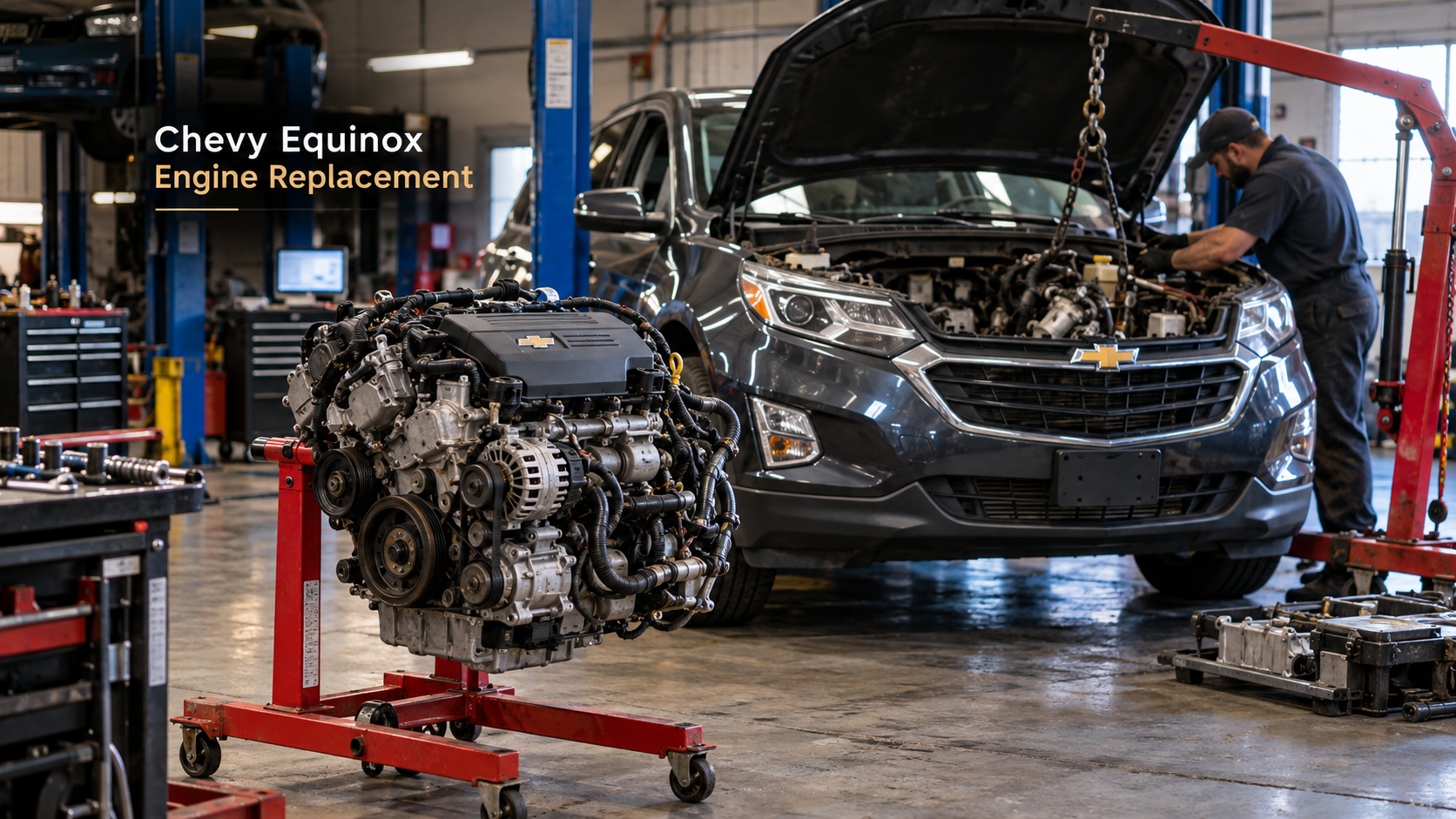
Before you spend a cent on an engine, take ten minutes to find out whether GM already owes you one. The 2.4L four-cylinder had a well-known oil-burning problem, and GM set up special coverage that paid dealers to fix it: pistons, rings and, where the damage had spread, the whole engine.
The 2.4L (LEA) Oil Consumption Special Coverage: Which Years, What It Paid For
GM's line in the sand was an engine that needed more than a quart every 2,000 miles because of worn piston rings. Most owners first noticed it through the oil-can light, an "Engine Oil Low – Add Oil" message or, when things got bad, "Oil Pressure Low – Stop Engine."
| Model year | Engine code | Coverage term |
|---|---|---|
| 2010 | 2.4L LAF | 10 years or 120,000 miles from in-service date |
| 2011–2012 | 2.4L LEA | 7.5 years or 120,000 miles |
| 2013 | 2.4L LEA | Special coverage N192291100, issued January 2020; terms in the owner letter |
| 2014–2017 | 2.4L LEA | No special coverage; excluded from the class settlement |
Here's how it worked in practice. The dealer ran an oil consumption test first. If the engine failed, GM paid for new pistons and rings, or a replacement engine if the bearings or cylinders were already damaged. Anyone who had paid for the repair out of pocket could claim the money back with receipts.
Where that leaves you in 2026: On paper, every one of these programs has expired. A 2013 Equinox that went on the road in spring 2013 ran out of its 7.5-year window back in 2020. Don't give up straight away, though. A class action covering 2010–2013 Equinox and Terrain 2.4L owners ended in a court-approved settlement, and GM has been known to offer goodwill on low-mileage cars with a clean service history. If you've kept your oil-change receipts, it's worth a phone call.
How to Check Your VIN for Open Recalls and Special Coverage
- Find your 17-character VIN. It's printed on the driver's side of the dashboard (you can read it through the windshield), on the sticker inside the driver's door jamb, and on your registration.
- Call any Chevrolet dealer's service desk and ask them to run the VIN through GM's warranty system. This is the only way to see open recalls, special coverage, past warranty claims and any goodwill repairs on your car. You can also check for open recalls yourself with the NHTSA recall lookup tool.
- While you have them on the phone, ask whether the engine was ever replaced under warranty. If it was, your Equinox may already have the updated pistons and rings, which changes what's likely wrong with it.
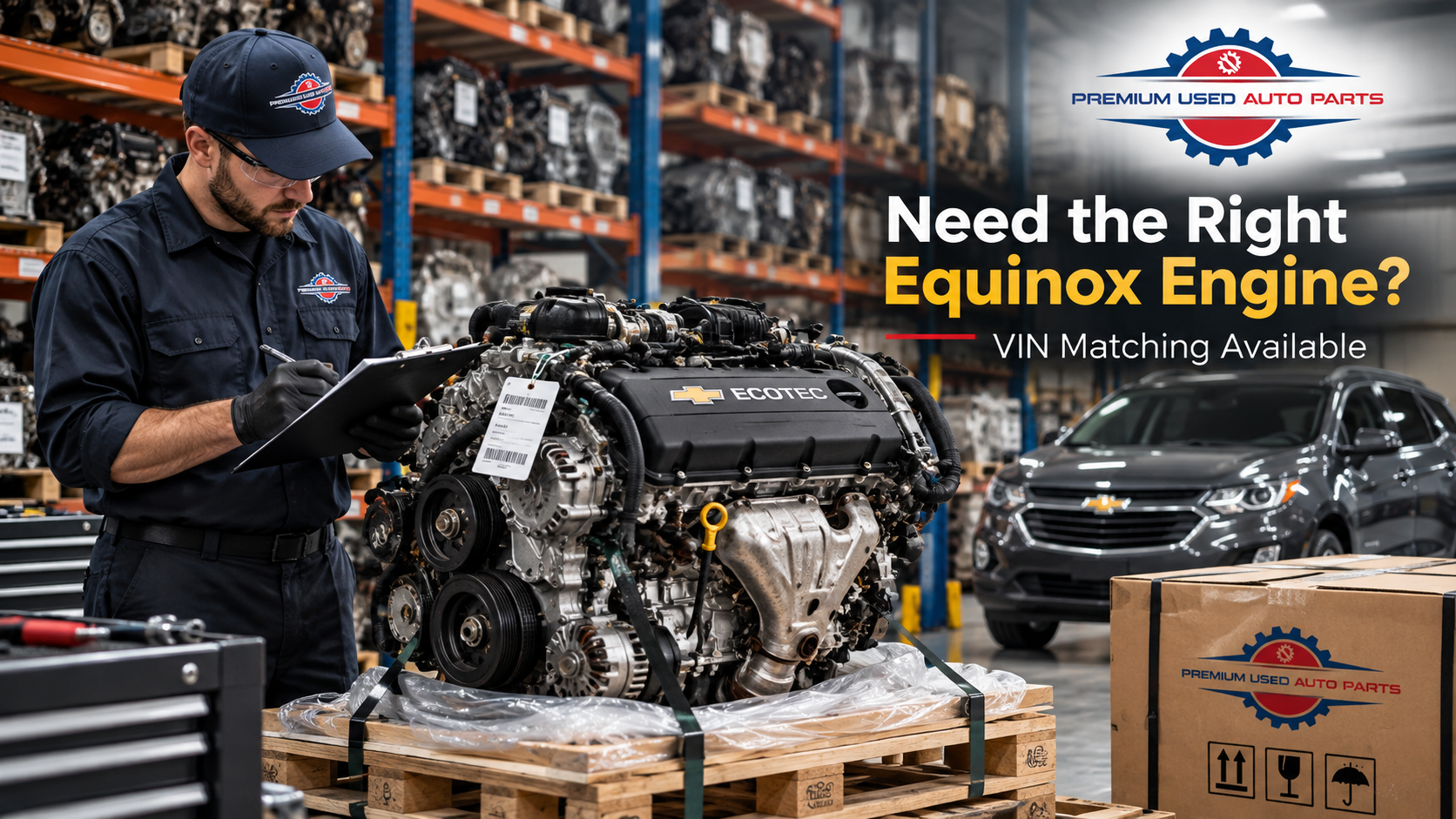
- If the coverage has run out or doesn't apply, send your VIN to Premium Used Auto Parts. The team will use it to match the exact engine your Equinox needs, so you get the right replacement the first time.
How to Tell Which Engine Is in Your Equinox
Get this right first, because everything else hangs off it: the price, the fault you're most likely dealing with and which used engines will actually bolt in. Chevy has put six different engines in the Equinox since 2010.
2.4L Ecotec LEA (2010–2017)
This is the one most people are asking about. It was the base engine for the entire second generation, badged LAF in 2010 and LEA from 2011 on. Both versions are direct-injected, chain-driven four-cylinders with roughly 182 hp. The oil-burning reputation belongs mostly to the 2010–2013 engines. GM changed the pistons and rings partway through production, and the 2014–2017 engines use far less oil, though not none.
3.0L / 3.6L V6 (2010–2017)
From 2010 to 2012 you could option a 3.0L V6 (LF1, later LFW). Its weak spot is the timing chain, which stretches and throws codes like P0008, P0016 or P0017. In 2013 GM swapped it for the 3.6L LFX, a tougher engine with fewer chain complaints. Being V6s mounted sideways, both take longer to swap, so expect a bigger labor bill than on the four-cylinder.
1.5L Turbo LYX (2018 Onward)
The third-generation Equinox runs this 170 hp turbo four as standard. Owners mostly report coolant loss, oil leaks and, on some early builds, cracked cylinder heads. A fully dead engine is much rarer than it was with the old 2.4L.
2.0L Turbo and 1.6L Diesel (2018–2020)
If you wanted more punch between 2018 and 2020, you got the 2.0L turbo LTG, good for 252 hp and paired with a nine-speed automatic. The 1.6L turbodiesel LH7 only lasted two model years, 2018 and 2019. Not many of either were sold, so used engines are harder to track down and cost more. A diesel can take weeks to source.
Where to Find the RPO Code on the Glovebox Sticker
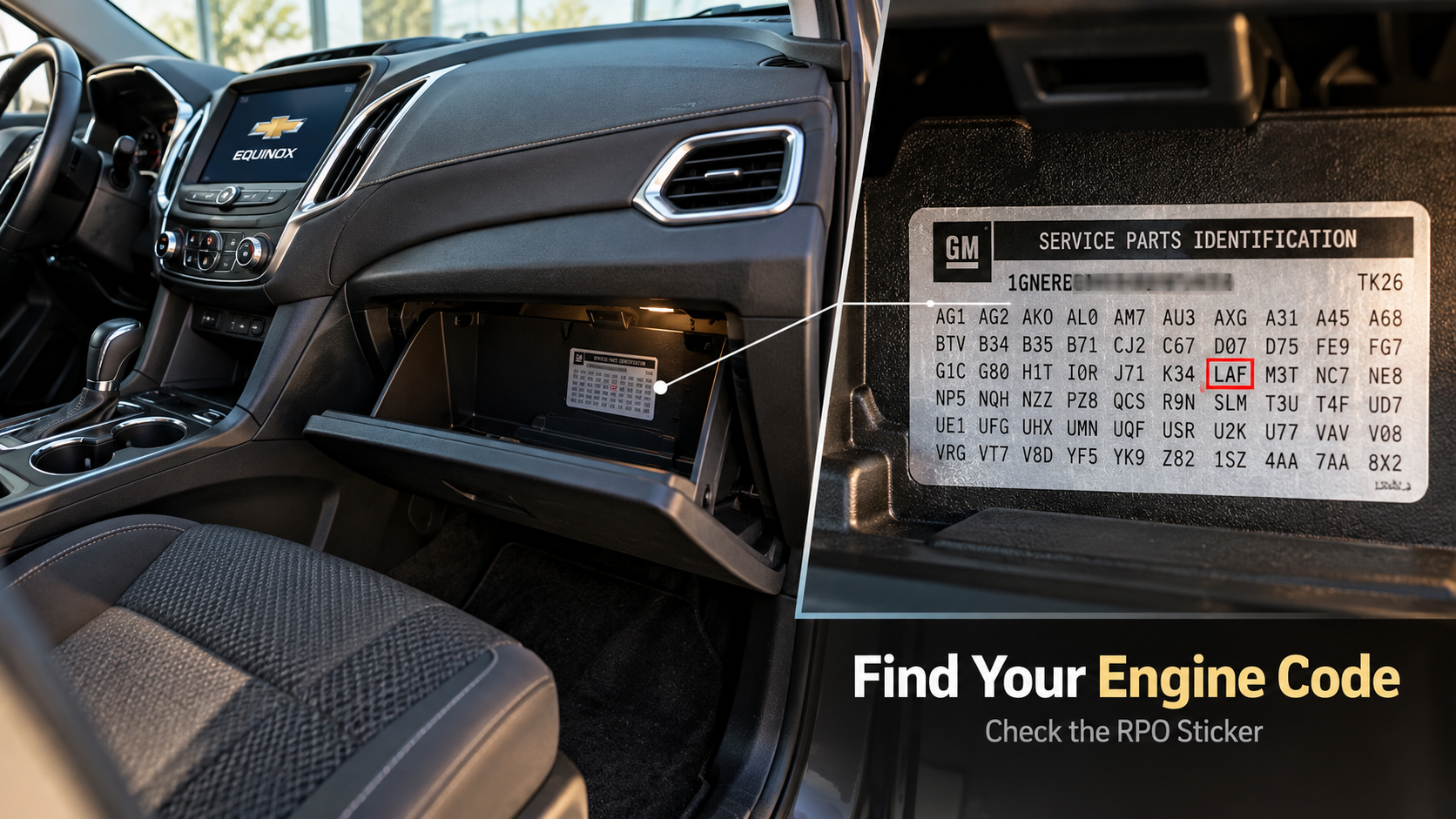
Pop open the glovebox and look for a white sticker covered in three-character codes. If you're also looking for other replacement components, you can browse our used Chevrolet parts by vehicle and part type. That's the Service Parts Identification label. Somewhere in that grid is your engine code: LAF or LEA (2.4L), LF1 or LFW (3.0L), LFX (3.6L), LYX (1.5T), LTG (2.0T) or LH7 (diesel). If the sticker is missing, the eighth character of your VIN tells you the engine, and any dealer can decode it in seconds. Give that code to every seller you call. Asking for "a 2.4 Equinox engine" is how people end up with the wrong one.
Equinox Engine Replacement Cost by Model Year
The older the car, the cheaper the fix, mostly because salvage yards are full of 2.4L donors. The 2018–2020 turbo and diesel models flip that around: fewer engines turn up, so you pay more. Every total below assumes a used engine fitted by an independent shop.
Read the low figure in each row as the four-cylinder price and the high figure as the V6, 2.0T or diesel.
One tip for 2010–2013 2.4L owners: it's worth paying a little extra for an engine out of a 2014 or newer car (more on that in the checklist below).
Why the 2.4L Fails: Stuck Piston Rings, Timing Chain Stretch, PCV
Something a lot of owners don't realize: the oil burning rarely kills a 2.4L on its own. What kills it is running low. Carbon gums up the low-tension oil control rings, oil vanishes faster than the oil-life monitor expects, and the engine quietly runs a quart or two short until a rod bearing gives up. Before anyone quotes you for an engine, match your symptom to its likely cause.
| Symptom | Likely cause | Engine or repair | Typical cost |
|---|---|---|---|
| Burns a quart every 1,000–2,000 miles, runs quietly, good compression | Carboned-up, stuck oil control rings | Repair: decarbon service, or pistons and rings | $150–$400 decarbon; $2,500–$3,500 rings |
| Oil loss plus oily intake, whistling or rough idle | Clogged PCV orifice between intake runners 2 and 3 | Repair | $150–$450 |
| Rattle at cold start, codes P0008, P0016, P0017 | Timing chain stretch or failed tensioner and guides | Repair, if caught before the chain jumps | $1,200–$2,200 |
| "Oil Pressure Low – Stop Engine" with oil at the full mark | Failing oil pump or pickup, or worn bearings | Diagnose first; often an engine | $800–$1,500 pump, or engine |
| Deep knock that rises with RPM, metal on the dipstick | Spun rod bearing from oil starvation | Engine | See price tables |
| Low compression, heavy blue smoke | Scored cylinders or broken rings | Engine | See price tables |
Burning a quart every 1,000 miles doesn't always mean the 2.4 is done. That rate is well past GM's own limit, but if the engine runs quietly and passes a compression and leak-down test, the bottom end is probably still healthy. Sort out the PCV, change the oil every 3,000–4,000 miles, top it up in between, and plenty of these engines keep going for years. It's finished when it knocks, loses compression or has run dry enough to starve the bearings.
Replace, Rebuild or Swap: The Cheapest Option for Your Equinox
In most cases, a used engine is the cheapest way to get a 2.4L Equinox back on the road. A ring job only comes out ahead when the bottom end is still sound, and a full rebuild only makes sense if you trust your machinist and plan to keep the car for a long time.
Switching to a different engine altogether, like dropping a 3.6L V6 into a car that left the factory with a 2.4L, is a separate and much pricier project. If replacement is the practical route, you can browse our selection of used engine to compare available options.
Equinox Engine Replacement Labor Costs and Time Off the Road
On a used-engine job, labor usually eats 30–45% of the bill; on a new engine it's closer to 20–30%. The Equinox makes mechanics work for it. The engine and transaxle normally come out together from underneath, still bolted to the subframe, so book times run longer than on a lot of compact cars.
The engine itself tends to show up within one to three days. The real hold-up is usually the shop's queue. So ask when they can get your car into a bay, not just how many hours the job takes, and check whether the quote covers moving your intake, injectors, sensors and wiring onto the replacement engine.
Used, Remanufactured or New: Three Routes Priced Side by Side
On a 2.4L, going used saves you roughly $2,000 up front compared with a reman. What the extra money buys is peace of mind: an engine you know is good, backed by a warranty measured in years rather than weeks. Here's the same 2.4L job priced three ways.
| 2.4L route | Used (salvage) | Remanufactured | New GM |
|---|---|---|---|
| Engine price | $1,000–$2,000 | $3,000–$4,500 | $4,000–$5,500 |
| Labor (10–13 hrs) | $1,100–$2,340 | $1,100–$2,340 | $1,100–$2,340 |
| Gaskets, fluids, small parts | $300–$600 | $300–$600 | $300–$600 |
| Installed total | $2,500–$4,800 | $4,500–$7,000 | $5,500–$8,000 |
| Warranty | 30 days–1 year, parts only | ~3 years / 100,000 miles, often with labor | GM parts warranty; labor covered if a dealer installs it |
| Condition | Unknown history, 60,000–120,000 miles | New rings, bearings, chain; updated parts | Factory new |
| Oil-burning risk | High if the donor is 2010–2013 | Low | Lowest |
A simple way to decide: if you're selling within two years, go used. If you plan to put another 50,000 miles or more on it, the reman usually works out cheaper per mile.
Replacing the Engine vs. Selling the Car: When Each Makes Sense
A good rule: put the engine in if the fixed car will be worth at least $1,500 more than the job costs, and the transmission and body are in decent shape. To work it out, you need three numbers: what the car is worth running, what it's worth with a dead engine, and the installed quote.
Let's run the numbers on a 2014 Equinox LT with a 2.4L, 135,000 miles and a spun bearing. These figures are for illustration; plug your own car into Kelley Blue Book or Edmunds and get a couple of local offers.
Sell it as-is and you walk away with about $1,200 and no car. Spend $3,500 on a used engine and you own a $5,500 car, around $800 better off, and you skip the hassle and risk of buying someone else's used vehicle. The $5,500 remanufactured engine, on the other hand, only earns its keep if you hang on to the car for years.
When a $4,000 Equinox needs a $5,000 engine. First, don't treat that $5,000 as the only number on the table. Ask an independent shop to quote a used engine; on a 2.4L it's often $3,000–$4,000. If the rest of the car is solid and a replacement would cost you $10,000 or more, a used engine is the cheapest transport you'll find. If the transmission is slipping or the rust is serious, sell it as-is and put the money toward something else.
Buying a Used Equinox Engine: 7 Things to Confirm First
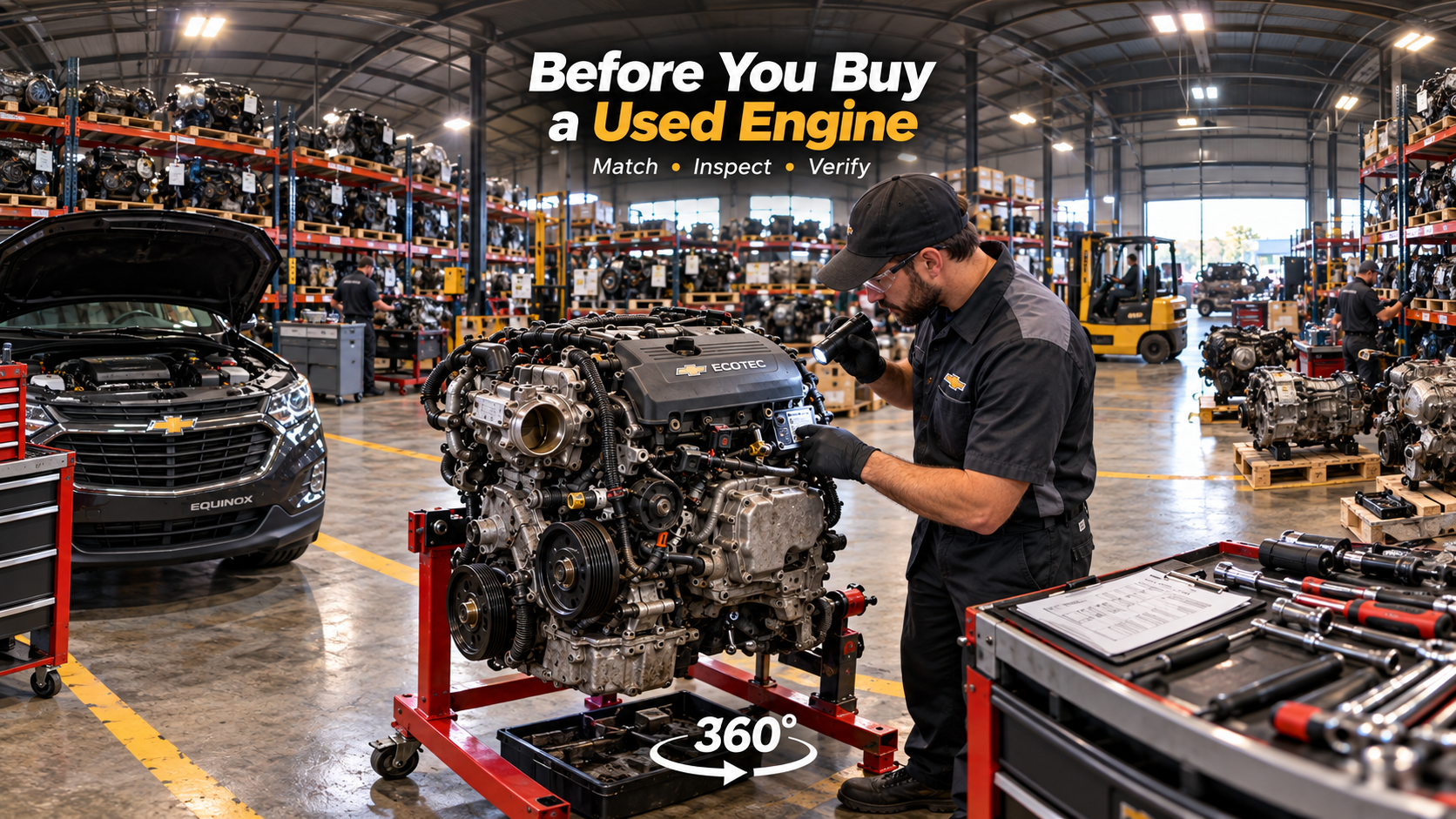
A used engine is only a bargain if it's the right engine and it's healthy. Get straight answers to these before any money changes hands, and get them in writing.
1. Match the Engine Code to Your RPO Sticker
The three-letter code needs to match exactly: LEA for LEA, LFX for LFX. A 2010 LAF and a 2011 LEA look almost identical, but the parts and calibration aren't the same. Check FWD versus AWD too, since some mounts and accessories differ.
2. Verify the Mileage and Ask for Proof
Ask for the donor car's VIN and a photo of its odometer. With the VIN you can look up the car's history and confirm its model year. For a 2.4L, try to stay under 100,000 miles.
3. Ask for a Compression Test or a Running Video
A decent yard will have compression readings for every cylinder, ideally within about 10% of each other, or a video of the engine running before it was pulled. If they can't give you either, keep shopping.
4. Check What the Warranty Covers and for How Long
Thirty days, parts only, is close to useless once you've paid for the labor. Hold out for three months, and ask whether the seller chips in on labor if the engine turns out to be bad.
5. Know Whether It's a Long Block or a Complete Engine
A complete engine arrives with the intake, injectors, sensors and wiring already on. That saves labor but also hides more unknowns. A long block means moving your own parts across. Make sure you know which one you're being quoted, or you'll be comparing apples with oranges.
6. Confirm the Shipping, Core and Return Terms
Shipping an engine usually costs $150–$400. Some sellers also hold a core deposit until your old engine comes back to them. Find out up front who pays the return shipping if the engine turns out to be faulty.
7. Find Out Why the Donor Car Was Scrapped
An engine from a car that was rear-ended is about as good as it gets. One from a flood car, a fire car or a "ran when parked" car is not. The donor VIN will usually tell you which you're getting.
Bonus: Choose a Donor Built After the Ring Fix
This is the question that matters most for an Equinox. GM reworked the 2.4L's pistons and rings, and engines from 2014–2017 cars attract far fewer oil-burning complaints than 2010–2013 ones. So if you're fixing a 2010–2013 car, a 2014–2017 LEA is the smarter buy; your shop may just need to reflash the engine computer. It's also worth asking whether the donor's engine was already replaced under GM's special coverage. If it was, it likely has the updated pistons fitted.
What Else Fails Around the Engine
Before you sign off on an engine, make sure one of these isn't the real culprit. And while the engine is out, it's the cheapest moment you'll ever get to replace the parts around it.
- Timing chain: a stretched chain rattles and throws cam codes, but it's a repair, not a new engine. Our Chevy Equinox timing chain replacement cost guide breaks down the price.
- Transmission: if the six-speed is slipping as well, the whole repair-or-sell decision shifts. See Chevy Equinox transmission replacement cost. If you're also researching related drivetrain components, our guide to the Chevy Silverado transfer case explains what to check before choosing a replacement.
- Alternator: a weak one can stall the car and light up the dash in a way that looks a lot like engine trouble. See Chevy Equinox alternator replacement cost.
- Mounts, water pump and thermostat: $300–$700 in parts during a swap, and the labor is already paid for.
Frequently Asked Questions
Conclusion
Most Equinox owners pay $2,500–$8,300 for a used engine, and the 2.4L is the cheapest to replace. Remanufactured and new engines cost more up front, which is why a quality used engine is the smartest choice for most owners.
Before you buy, confirm the engine is really finished, get at least two quotes and compare them with your car's value. If you drive a 2010–2013 model, choose a replacement engine from a 2014–2017 car and check your oil often.
Premium Used Auto Parts makes that easy. The team stocks used Equinox engines for every model year and uses your VIN to match the right one the first time. Search the inventory or send your VIN to get started.

The Premium Used Auto Parts Editorial Team is backed by years of experience in the automotive parts industry and creates practical, research-driven content for vehicle owners, repair shops, and DIY enthusiasts across the USA. Our team combines real-world parts expertise with industry research to help drivers make informed decisions about OEM replacement parts, vehicle repairs, and maintenance. Every article is developed with a commitment to accuracy, transparency, and delivering reliable information that supports smarter vehicle ownership.