Chevy LS1 vs LS3 vs LSX: Which LS Engine Should You Buy?
Table of Contents
10 ChaptersWhy This Choice Costs You Twice If You Get It Wrong
Most people comparing the Chevy LS1 vs LS3 vs LSX aren't collecting spec sheets — they're deciding where four thousand dollars goes. Choose wrong and you pay twice: once at purchase, again when the block can't take the boost you planned.
Here's what actually separates them.
One Bore Spacing, Three Different Answers
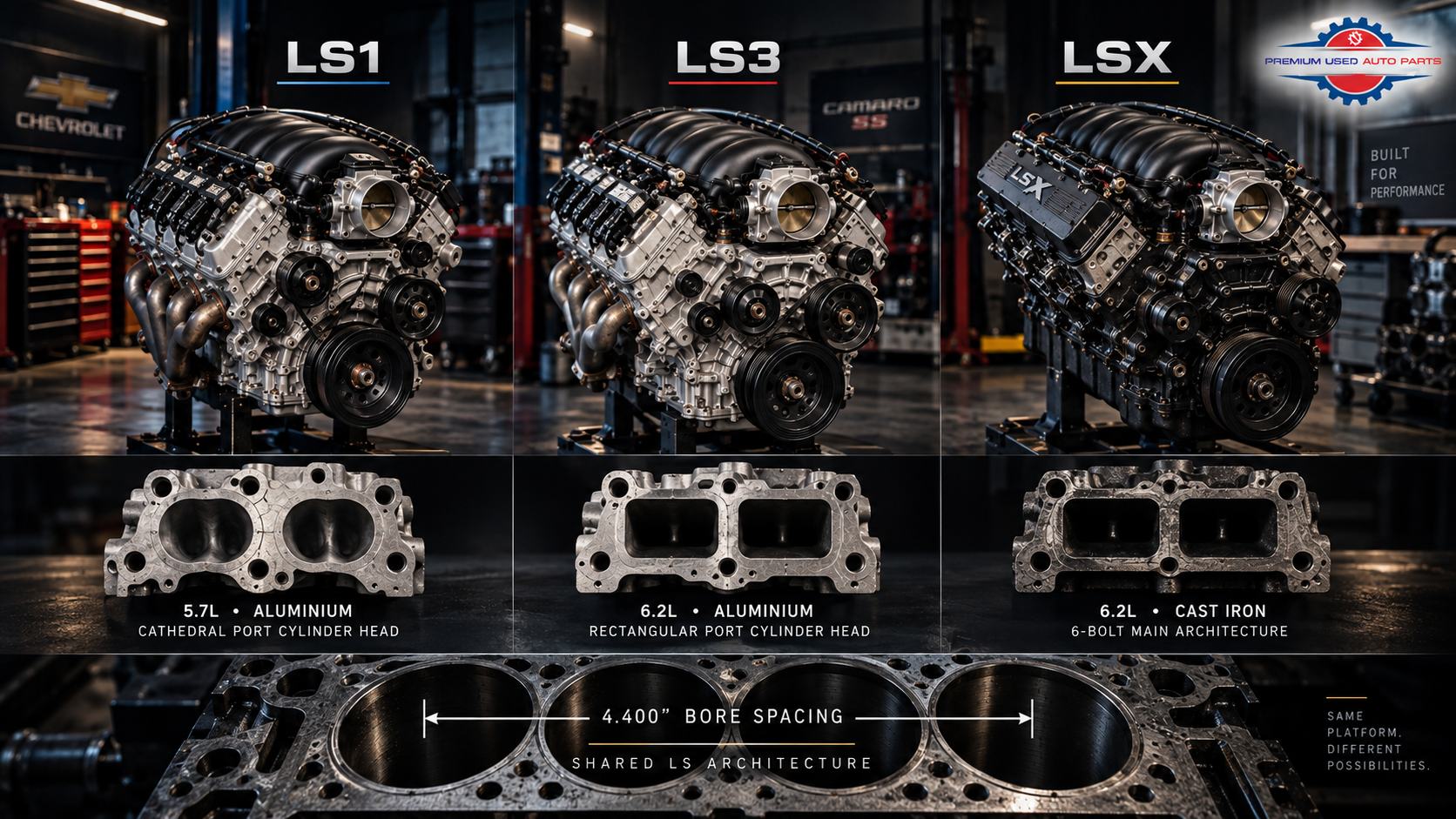
Every LS shares 4.400-inch bore spacing and the same cam-in-block pushrod layout. The family began with the 1997 C5 Corvette and grew through Gen IV into today's LT and LSX branches. That shared architecture is why LS engines dominate swaps — heads, camshafts and accessory brackets move between generations with minimal fuss.
What changes is displacement, block material, and how much abuse the casting absorbs.
LS1: The 1997 Corvette Engine That Retired the Old Small Block
Chevrolet introduced the LS1 in the C5 Corvette for 1997, rated at 345 horsepower at 5,600 rpm and 350 lb-ft of torque at 4,400 rpm. It's a 5.7-litre, 346-cubic-inch all-aluminium V8 that also appeared in the 1998-2002 Camaro Z28 and SS, Firebird Trans Am and GTO.
It remains the cheapest genuine car-spec LS. Cathedral-port heads flow less than later designs, but the block handles 500 to 550 horsepower naturally aspirated. For a street build with a cam and a tune, it's still the value pick — and clean LS1 motor options among our used engines surface regularly.
LS3: 430 Horsepower Before You Touch Anything
The LS3 is a Gen IV small-block V8 displacing 376 cubic inches (6.2L), rated at 430 horsepower at 5,900 rpm and 425 lb-ft at 4,600 rpm, with a cast aluminium block and six-bolt cross-bolted main caps. Bore and stroke measure 4.065 by 3.622 inches.
It served as the standard engine in the fifth-generation Camaro SS and the C6 Corvette, pairing an aluminium block with L92-type rectangular-port heads for a 10.7:1 compression ratio.
Those rectangular ports are the real upgrade. They flow substantially better than the LS1's cathedral design, that's why LS3 heads get bolted onto older blocks constantly. If you want maximum horsepower with minimum work, this is the answer — and it's where "what is the best LS engine" usually lands. The LS6, its 5.7-litre predecessor from the Z06, still trades power for displacement it doesn't have.
LSX: A Cast-Iron Block Built to Swallow Boost
The LSX isn't a single engine. Chevrolet Performance introduced the LSX cast-iron racing block at the 2006 SEMA show, based on the LS7 and built with forged components.
The LSX crate range is built on the LSX Bowtie Block using race-engineered combinations never offered in production vehicles — the LSX376-B15 makes 473 hp at 6,000 rpm, the LSX376-B8 makes 476 hp, and the LSX454R reaches 627 hp at 6,300 rpm. All use cast iron with six-bolt, cross-bolted main caps and a 9.0:1 compression ratio suited to forced induction.
The trade-off is weight — roughly 100 pounds more than aluminium. Buy an LSX only if you're running a turbo or supercharger that would crack a factory casting. Builders going that route usually pair it with upgraded used cylinder heads and a matched boost package.
LS1, LS3 and LSX Side by Side
Your Budget Picks This, Not Your Ambition
Four Checks Before You Buy a Used LS
- Request the casting number and confirm the generation.
- Verify compression across all eight cylinders.
- Get donor mileage in writing.
- Confirm what's included — a bare long block costs another $800 or so to complete.
Our 10-point checklist before buying used auto parts online walks through verification in detail, every used LS engine ships under our warranty terms, and you can browse fitment in the Chevrolet parts catalog
Final Words
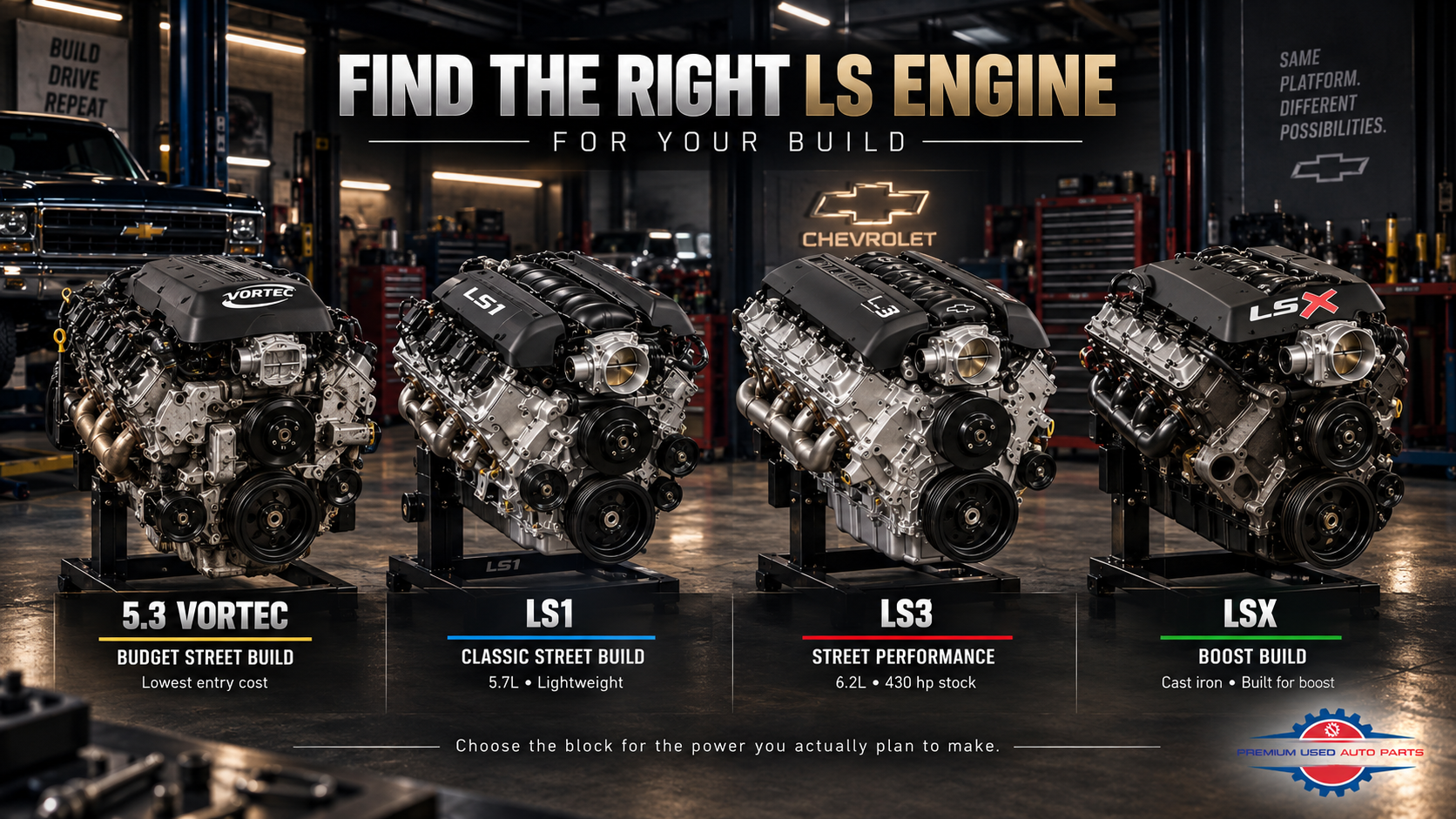
For most street builds, the LS3 is the right answer — 430 horsepower with no modification and the best-flowing factory heads in the family. Pick the LS1 if budget leads and you're willing to work for power. Pick an LSX only when boost is in the plan, because you're paying in weight for strength you may never use. Whichever you choose, verify casting numbers and compression before money changes hands.
Six Questions Buyers Keep Asking

The Premium Used Auto Parts Editorial Team is backed by years of experience in the automotive parts industry and creates practical, research-driven content for vehicle owners, repair shops, and DIY enthusiasts across the USA. Our team combines real-world parts expertise with industry research to help drivers make informed decisions about OEM replacement parts, vehicle repairs, and maintenance. Every article is developed with a commitment to accuracy, transparency, and delivering reliable information that supports smarter vehicle ownership.