8 Chevy Silverado Transfer Case Symptoms, Costs & Fixes
Table of Contents
15 ChaptersIntroduction
A transfer case Chevy Silverado owner suspects is often innocent. Several different components produce nearly identical signs, and the cheap ones sit on the outside of the housing where they're easy to reach — so shops that skip the diagnosis quote the expensive fix by default.
The other trap is fitment. A 2003 Silverado, a 2011 truck, and a 2016 truck use three different unit families that share almost nothing. A transfer case Chevy Silverado 1500 setup differs from the HD version in the same year, and the 2007 model year alone covers two incompatible body styles.
Model year alone won't identify yours. That's why points of symptom transfer case symptoms mentioned below matter as much as any symptom below — most wasted money in this repair is spent on the right diagnosis and the wrong part. Following these steps can help you avoid unnecessary repairs and costly ordering mistakes.
1. Grinding or Crunching Under the Cab
Urgency: stop driving, tow it. Typical cost: $900-$1,500 installed.
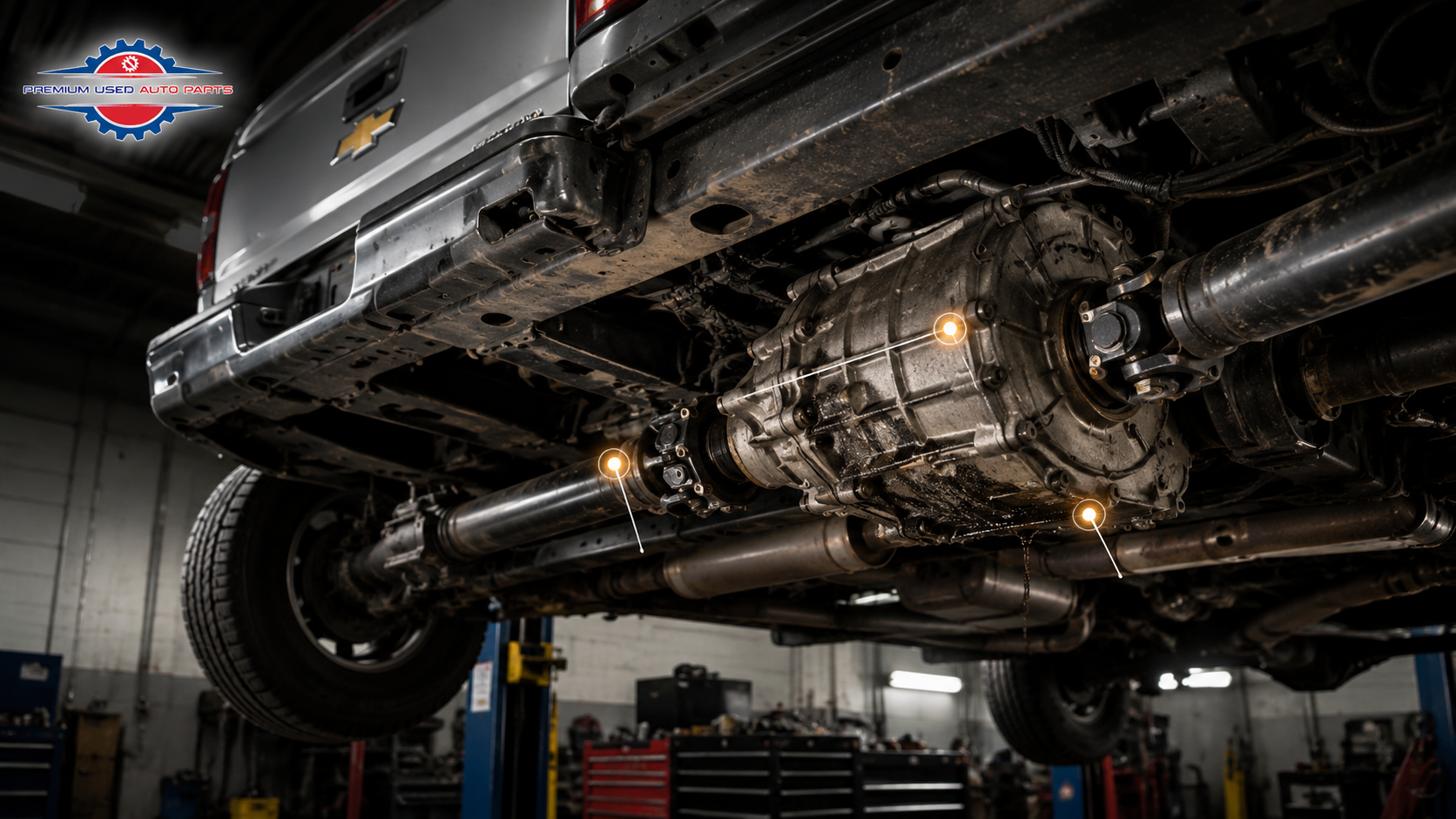
Metal hitting metal inside the housing — broken gear teeth, collapsed bearings, a snapped chain, or fluid that escaped unnoticed. Of all bad transfer case symptoms, this is the only one that gets more expensive by the mile.
Worth knowing: grinding is rarely the first warning — it's usually the fourth. On a transfer case of a 03 Silverado or a transfer case of a 04 truck, it typically follows years of a whine nobody chased.
2. Whining That Rises With Road Speed
Urgency: days, not weeks. Typical cost: $60 for a service, $900-$1,500 if ignored.
A whine that climbs with vehicle speed rather than engine RPM is wear that hasn't become damaged yet.
Quick test: while rolling, shift to neutral and lift off. If the pitch tracks wheel speed, it's the drivetrain. If it tracks the tachometer, look at the engine.
Worn bearings cause most of it — though a driveshaft carrier bearing can sound nearly identical.
3. "Service 4WD" With a Quiet Drivetrain
Urgency: safe to drive in two-wheel drive. Typical cost: $30-$600.
The most common complaint, and the likeliest to save you money. A warning on a silent drivetrain is usually electrical: an encoder motor, a cracked dash-switch solder joint around $30, or corroded module grounds.
Fast review: A fault that comes and goes is a connection, not a failing case.
4. Four-Wheel Drive Won't Engage, With a Click
Urgency: safe to drive in two-wheel drive. Typical cost: $65-$500.
That click is the transfer case encoder motor trying to shift the case and failing. Suspects: the motor, its position sensor, or the front axle actuator at $65-$150.
Ask for the code. C0327 points at the encoder circuit — worth several hundred dollars.
5. Shuddering in Auto During Slow Turns
Urgency: low. Typical cost: $60-$150 if caught early.
The clutch pack is slipping rather than gripping. Degraded fluid causes it most often; the wrong fluid causes it too, because ordinary ATF isn't designed for a clutch pack.
This is generation-specific. It's common on an 03 Silverado through the 2013 trucks and rarer on 2014 and later, which use a different clutch arrangement. If your transfer case 2015 Chevy Silverado setup is shuddering, check tyres and driveline angles before condemning the unit — on that generation the cause is usually outside the case.
Prevention: Replace tires in matched sets. Uneven rolling diameters make the system engage constantly.
6. Stuck in Neutral, or Stuck in 4WD
Urgency: high — the truck may not move. Typical cost: $200-$1,500.
Usually a stalled encoder motor. Behind it: a worn shift fork, a failed control module, or damage that's jammed the mechanism.
This is largely a 2007-2013 complaint. A transfer case 2015 Chevy Silverado setup rarely does it, and when a newer truck does, the module is the likelier cause than the motor.
Try this first: ignition fully off, wait sixty seconds, restart, then cycle the selector slowly with the truck stopped. A stalled encoder sometimes reindexes — a reprieve, not a repair.
7. Fluid Leaking Behind the Transmission
Urgency: days. Typical cost: $150 for a seal, $900 or more if it runs dry.
A transfer case leak is worth chasing immediately, because running low turns the other faults here from repairable into terminal. Output shaft seals are the ordinary source, then the adapter seal at the transmission joint.
Watch the rear of the housing specifically on an 04 Silverado and the other GMT800 trucks. That generation has a known slow leak that appears there rather than at the seals, and it drains the case so gradually most owners never spot it until the noise starts.
Prevention: thirty seconds at every oil change looking under the case.
8. Burning Smell After a Drive
Urgency: stop and check the fluid level before driving further.
The fluid has stopped working, and the clutches are running hot. Almost always a leak nobody chased.
Prevention: use AUTO rather than 4HI on pavement, and don't leave it there after the snow clears.
How to Identify the Correct Transfer Case for Your Chevy Silverado
A transfer case 03 Silverado or transfer case 04 Silverado owner should check fluid before assuming anything internal. These trucks are over twenty years old now, and fluid that was never changed does more damage than mileage ever will — age, not miles, is the dominant factor on the GMT800s.
A transfer case 2004 Chevy Silverado 1500 and its HD sibling from the identical model year are different parts, with different mounting and fluid capacity. Listings that say "fits Silverado" without specifying 1500 or HD aren't telling you enough to buy safely.
At the other end, a transfer case 2015 Chevy Silverado complaint is more often the driveshaft carrier bearing than anything inside the case. These trucks simply aren't old enough for genuine internal wear to be common, so rule out the cheaper part first.
Which Silverado You Have Decides What You Order
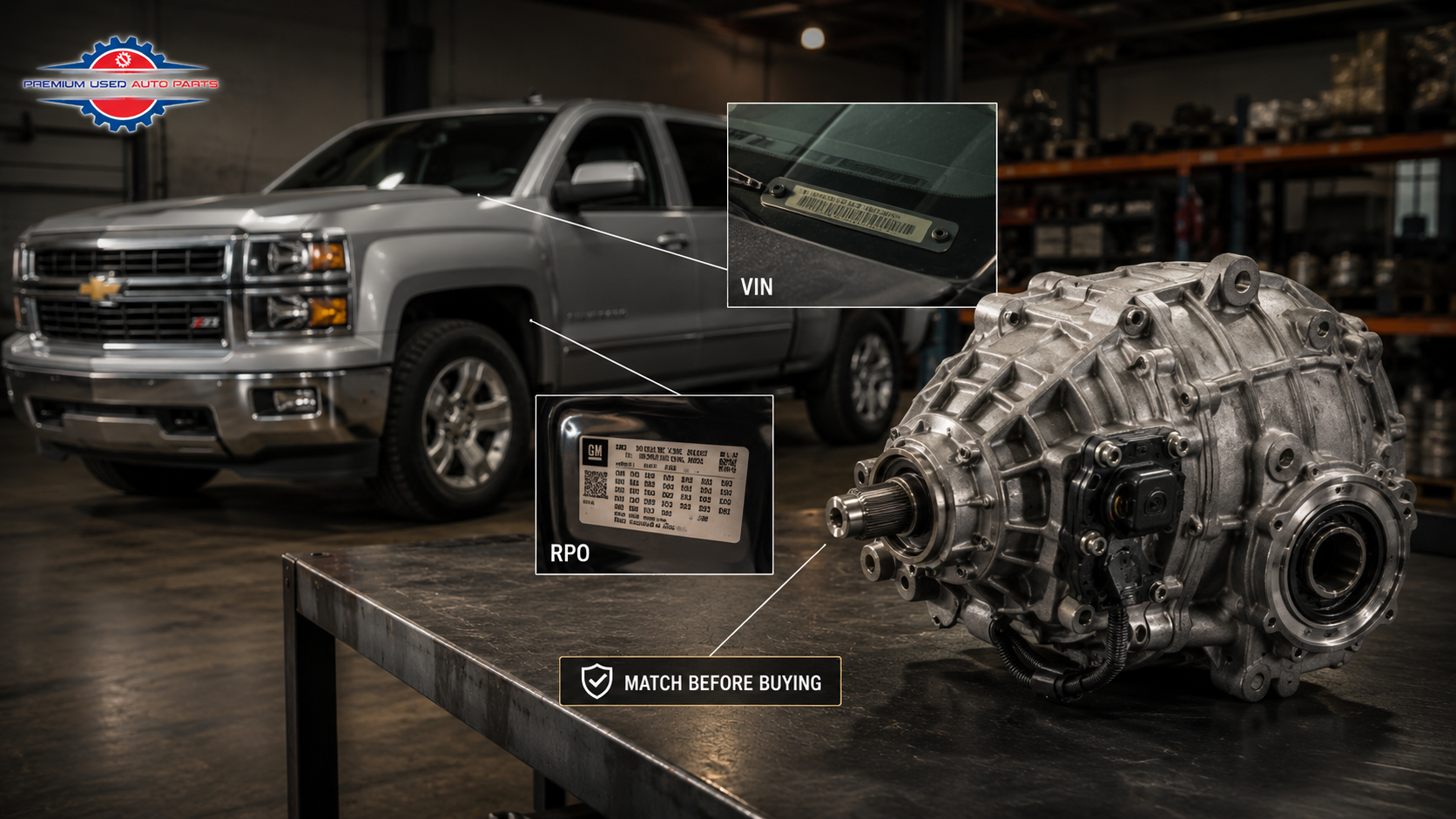
Three things identify the unit, and none of them is the model year on its own.
- The RPO sticker inside your glovebox lists the transfer case option code — NP8, NP2, or NP3. This is the fastest route.
- The eighth character of your VIN narrows the drivetrain configuration, which matters most on split years like 2007.
- Cab and bed configuration affects output shaft length on some units, so two trucks with matching RPO codes can still take different parts.
A transfer case Chevy Silverado 1500 listing that quotes only a year range isn't enough to order from. Neither is a transfer case 03 Silverado listing that doesn't say whether it came from a 1500 or a 2500. Ask the seller which VIN the unit was pulled from — any reputable yard will know.
What Each Fix Costs
Match the Unit to Your VIN, Not Your Model Year
This is where the money is actually lost, and it's the most common cause of returns in this category.
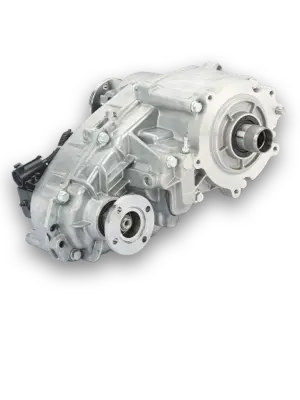
A transfer case Chevy Silverado 1500 differs from the HD unit built in the same year. The 2007 model year alone covers two incompatible body styles sold simultaneously. And nothing from 2013 or earlier fits a 2014-and-later truck, however alike they look from underneath.
What identifies your unit is the RPO code on the sticker inside your glovebox, or your 17-digit VIN. Not the year on the title.
Send us your VIN and we'll confirm the exact unit yours takes and what it costs, usually within minutes. Every unit we ship is spin-tested, VIN-matched rather than year-matched, and covered by a 90-day warranty. We ship to all 48 continental states, typically in 3–7 business days.
Before You Accept Any Quote
Three checks settle nearly every point above, and none costs anything:
- Scan for codes. C0327 means encoder motor, not transfer case.
- Check the fluid and the rear of the housing for staining.
- Note whether the noise follows road speed or engine RPM.
The gap between an encoder motor and a full case is around a thousand dollars.
Frequently Asked Questions
Conclusion
Understanding transfer case symptoms is about making informed decisions rather than reacting to the first sign of trouble. Some issues can be resolved with routine maintenance or minor component replacements, while others require more extensive repairs. Recognizing the difference helps you plan repairs at the right time and avoid replacing parts that are still serviceable.
Whether you're troubleshooting a current issue or preparing to purchase a replacement, taking a methodical approach will save both time and money. Inspect the system carefully, confirm the exact transfer case specification for your Silverado, and work with a supplier that can verify compatibility before you buy.
If you're ready to replace your transfer case, explore our inventory of quality-tested, VIN-compatible Chevy Silverado transfer cases. Our team can help you identify the correct unit for your truck and ensure you receive a reliable replacement that gets you back on the road quickly.

The Premium Used Auto Parts Editorial Team is backed by years of experience in the automotive parts industry and creates practical, research-driven content for vehicle owners, repair shops, and DIY enthusiasts across the USA. Our team combines real-world parts expertise with industry research to help drivers make informed decisions about OEM replacement parts, vehicle repairs, and maintenance. Every article is developed with a commitment to accuracy, transparency, and delivering reliable information that supports smarter vehicle ownership.