VW Jetta Engine Replacement Cost: Used, Reman & New Prices
Table of Contents
14 ChaptersIntroduction
A VW Jetta engine replacement cost usually falls between $2,500 and $7,500 when a used engine goes in at an independent shop. Where you land depends on the engine, how badly the old one failed, and whether you buy used, remanufactured or new.
Chances are a mechanic just gave you bad news. A GLI's chain skipped and bent the valves. A 1.4T is misfiring at 60,000 miles. Or a TDI that dodged the buyback finally needs a block. Each has a different answer, and this guide covers all three.
How Much Does a VW Jetta Engine Replacement Cost?
Most VW Jetta engine replacements cost $2,500 to $7,500 installed with a used OEM engine. Non-turbo 2.0L and 2.5L models sit at the low end, the 1.4T, 1.5T and 1.8T in the middle, and the GLI 2.0T and TDI at the top.
Those figures assume an independent shop billing $120 to $170 an hour. At a VW dealer, add 20 to 40 percent.
These are late-2026 estimates, and donor mileage moves them most. Budget $200 to $500 more for fluids, gaskets and a thermostat.
Check The Timing Chain Tensioner Settlement and Recalls First
Before paying for an engine, spend five minutes checking whether anyone else owes you. For most Jettas today, nobody does. Check anyway.
Which EA888 engines were in the tensioner class action
The first EA888 2.0T engines had a tensioner that could bleed down and let the chain go slack. The warning was often a two-second rattle on cold starts. Once the chain jumps a tooth, valves hit pistons.
A class action filed in New Jersey ended in a settlement that got final court approval in March 2019. The Jetta sedans it named were:
- 2008 to 2010 models with the 2.0T EA888
- 2012 to 2014 models with the 2.0T EA888, which in practice means the GLI
VW repaid past repairs and extended chain coverage to 10 years or 100,000 miles from the in-service date. A 2014 GLI sold that year lost coverage in 2024, so for nearly every Jetta the window is shut. A second VW timing chain settlement, approved in 2024, covered only certain Audi models.
Why does it still matter? It tells you which engines carry the risk. A covered-year engine without the revised tensioner can fail tomorrow, and so can a used engine pulled from the same year.
How to check your VIN
The VIN is on the driver's side of the dashboard and on the door jamb. Character 10 is the model year (A = 2010, B = 2011, E = 2014, F = 2015). Put the full VIN into the federal government's recall search, or call any VW service desk, to see open recalls and completed campaigns. Ask, too, whether the chain or tensioner was ever replaced.
TDI owners should also confirm the approved emissions fix was done. Modified cars got an extended emissions warranty that may still cover some engine parts.
Which Engine Is In Your Jetta?
Some model years offered four different engines, so the trim badge tells you more than the year does.
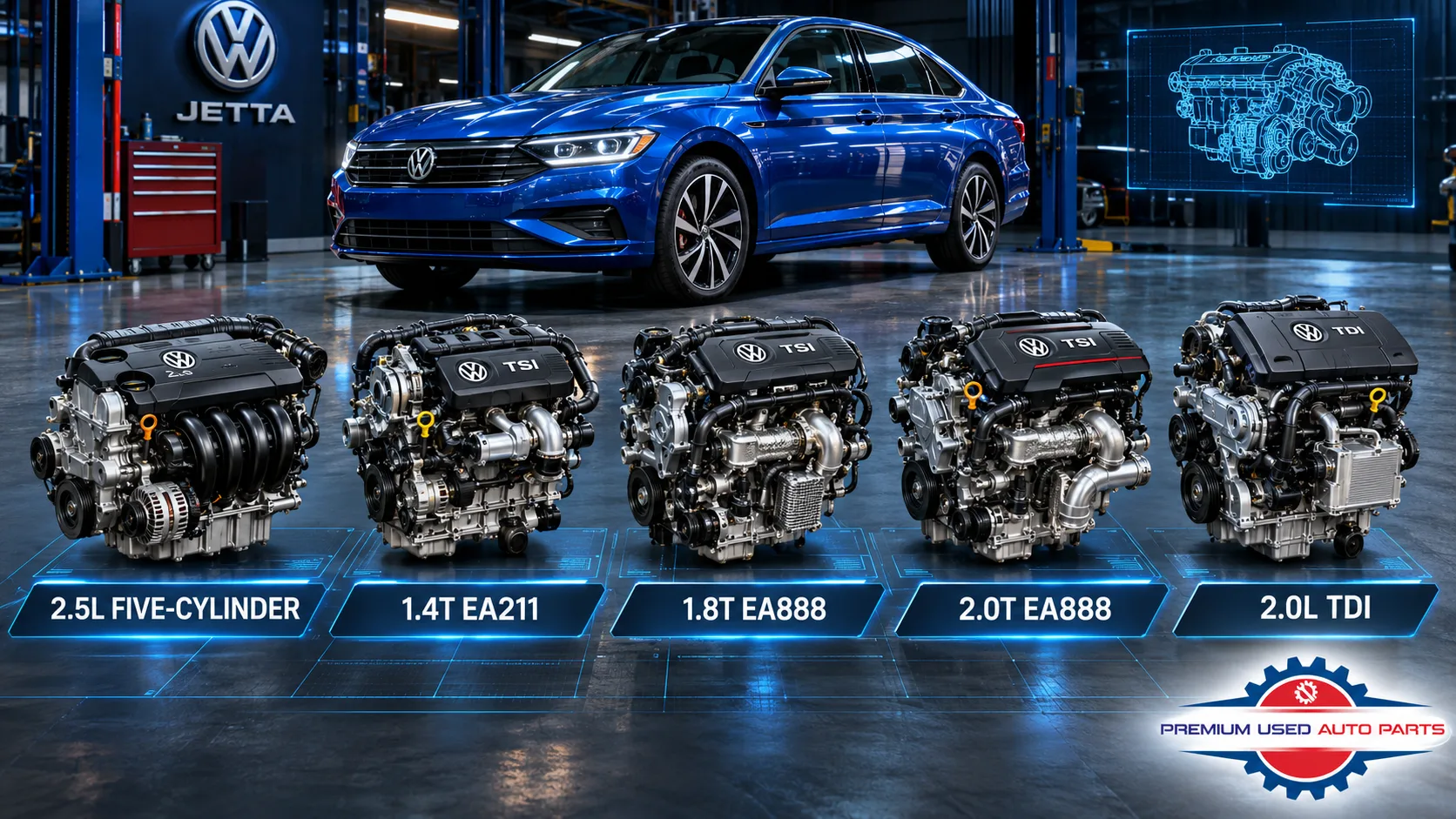
2.5L five-cylinder (2005–2014)
An inline five with a timing chain and no turbo. Slow, thirsty and very hard to kill, it powered the SE and SEL until the 1.8T took over in 2014. Early codes are BGP or BGQ; later ones CBTA or CBUA. Donors are everywhere.
Base S models from 2010 to 2015 used a 115 hp 2.0L 8-valve four (CBPA or CCCA). It's the cheapest Jetta engine to replace.
2.0L TSI / 1.8T EA888
If a Jetta owner tells you "the chain jumped," it's probably one of these.
- 2.0T, 2008 to 2010: the 2.0T trims and Wolfsburg Edition. A handful of very early 2008 cars still had the older EA113 (BPY). The rest got the EA888 (CCTA or CBFA) with the first-generation tensioner.
- GLI 2.0T, 2012 to 2014: EA888 with that same early tensioner.
- 1.8T, 2014 to 2018: third-generation EA888 (CPKA or CPRA) with a fixed tensioner. Its weak spots are the water pump and PCV valve.
- GLI 2.0T, 2015 on: also third-generation EA888, revised again for the 2019 redesign.
1.4T and 1.5T EA211 (2016 onward)
The 1.4T arrived for 2016. Engine code CZTA covers 2016 to 2018 Jettas, and the 2019 to 2021 cars use DGXA or DJXA. It was the only regular Jetta engine from 2019 to 2021, and it uses a timing belt rather than a chain.
The known weak spot is a recall. Under recall 17V070, certain 2017 Jettas with the 1.4L engine could seize because of an improperly cast engine block. Before you buy a used 2017 1.4T, check the donor car's VIN for that recall. On any 1.4T, a misfire stuck on one cylinder plus one low compression reading points to internal damage, and the fix is a short block or a replacement engine.
The 1.5T EA211 evo (DADA) took over for 2022. No failure pattern yet, and many are still under warranty.
The 2013 to 2016 Jetta Hybrid used its own 1.4T, so a regular one won't drop in.
2.0L TDI diesel
The EA189 (CJAA and related codes) ran from 2009 to 2014, then the EA288 for 2015. VW bought most back in 2016, but thousands were fixed and kept.
Is a TDI worth a new engine after the buyback? With the emissions fix, a clean body and a healthy DSG, often yes. These engines regularly pass 250,000 miles. The danger is the high-pressure fuel pump, which can shed metal through the injectors and turn a pump job into an engine-and-fuel-system job.
Reading the engine code on the block
You'll find the three- or four-letter code in two places:
- The vehicle data sticker, under the trunk carpet near the spare wheel and often in the service booklet.
- The block. It's stamped on a flat pad, usually close to where the engine bolts to the transmission.
Keep it with your VIN. A seller needs both.
Jetta Engine Replacement Cost By Model Year (2005 To 2026)
Find your year, then your trim. Prices are estimates for a used OEM engine plus independent-shop labor.
| Years | Engine (trims) | Code | Used engine | Installed |
|---|---|---|---|---|
| 2005–2007 | 2.5L five (Value Edition, 2.5) | BGP / BGQ | $800–1,600 | $2,500–4,000 |
| 2005–2006 | 1.9L TDI | BRM | $1,500–3,000 | $3,500–5,500 |
| 2005–early 2008 | 2.0T FSI EA113 (2.0T, GLI) | BPY | $1,200–2,500 | $3,300–5,300 |
| 2008–2009 | 2.5L five (S, SE, SEL) | CBTA / CBUA | $900–1,800 | $2,600–4,200 |
| 2008–2009 | 2.0T EA888 (2.0T, Wolfsburg) | CCTA / CBFA | $1,500–2,500 | $3,800–5,500 |
| 2009 | 2.0L TDI | CJAA | $2,000–3,200 | $4,000–6,000 |
| 2010 | 2.0L 8-valve (S) | CBPA / CCCA | $800–1,500 | $2,500–3,800 |
| 2010 | 2.5L five (SE, SEL) | CBTA / CBUA | $1,000–1,800 | $2,800–4,200 |
| 2010 | 2.0T EA888 (Wolfsburg, 2.0T) | CCTA / CBFA | $1,500–2,500 | $3,800–5,500 |
| 2010–2014 | 2.0L TDI | CJAA | $2,000–3,200 | $4,000–6,000 |
| 2011–2015 | 2.0L 8-valve (S) | CBPA / CCCA | $900–1,600 | $2,600–4,000 |
| 2011–2014 | 2.5L five (SE, SEL) | CBTA / CBUA | $1,100–2,000 | $2,900–4,500 |
| 2012–2014 | 2.0T EA888 (GLI) | CCTA / CBFA | $1,800–3,000 | $4,000–6,000 |
| 2014–2018 | 1.8T EA888 (SE, SEL, Sport) | CPKA / CPRA | $1,500–2,800 | $3,500–5,600 |
| 2015 | 2.0L TDI | EA288 | $2,500–3,500 | $4,500–6,500 |
| 2015–2018 | 2.0T EA888 Gen 3 (GLI) | Gen 3 | $2,200–3,500 | $4,500–6,500 |
| 2016–2018 | 1.4T EA211 (S, SE, SEL) | CZTA | $1,500–2,800 | $3,300–5,300 |
| 2019–2021 | 1.4T EA211 (S, SE, SEL, R-Line) | DGXA / DJXA | $1,800–3,200 | $3,600–5,700 |
| 2019–2024 | 2.0T EA888 Gen 3 (GLI) | Gen 3 | $2,800–4,500 | $5,000–7,500 |
| 2022–2024 | 1.5T EA211 evo (S, SE, SEL) | DADA | $2,500–4,000 | $4,300–6,800 |
| 2025–2026 | 1.5T EA211 evo (S, Sport, SE, SEL) | EA211 evo | $3,000–4,500 | $4,800–7,000 |
| 2025–2026 | 2.0T EA888 (GLI) | EA888 Gen 3 | $3,500–5,500 | $5,500–8,000 |
Older means cheaper, because there are more donors. Own a 2022 or newer? Call the dealer first; it may still be under VW's powertrain warranty.
Signs Your Jetta Engine Needs Replacing
A Jetta engine usually needs replacing, not repairing, when the damage is inside the block. These are the signs a mechanic looks for:
- Deep knocking from the bottom end that gets louder with revs, usually a spun rod bearing.
- Low or zero compression on one or more cylinders, confirmed with a compression or leak-down test.
- Oil in the coolant or milky oil: often a head gasket, but on a turbo engine it can mean a cracked head or block.
- Metal flakes on the dipstick or in the oil filter.
- A misfire stuck on one cylinder with a flashing check-engine light that new coils and plugs don't fix.
- Heavy blue smoke and oil use above 1 quart per 1,000 miles.
- No start after the chain or belt jumped, with cranking that sounds fast or uneven.
One sign on its own isn't proof. Ask for a compression test and a borescope look before you buy an engine, so you don't replace one that only needs a head job or a PCV valve.
Timing Chain Repair Vs Full Engine: When Damage Is Too Far Gone
A skipped chain doesn't always kill the engine. What matters is how far the damage went.
- Stretched but not skipped: you caught it in time. A chain, guide and tensioner kit costs about $1,500 to $2,900 at an independent shop, most of it labor. A stored P0016 cam/crank correlation code is often the early warning.
- Skipped, valves bent: the head comes off for new valves and guides and a warp check. With a chain kit, plan on $3,500 to $5,500.
- Too far gone: pistons dented or cracked, cylinder walls scored, pieces of chain guide in the oil pan, or a cam phaser in bits. At that point a used engine costs less than fixing this one.
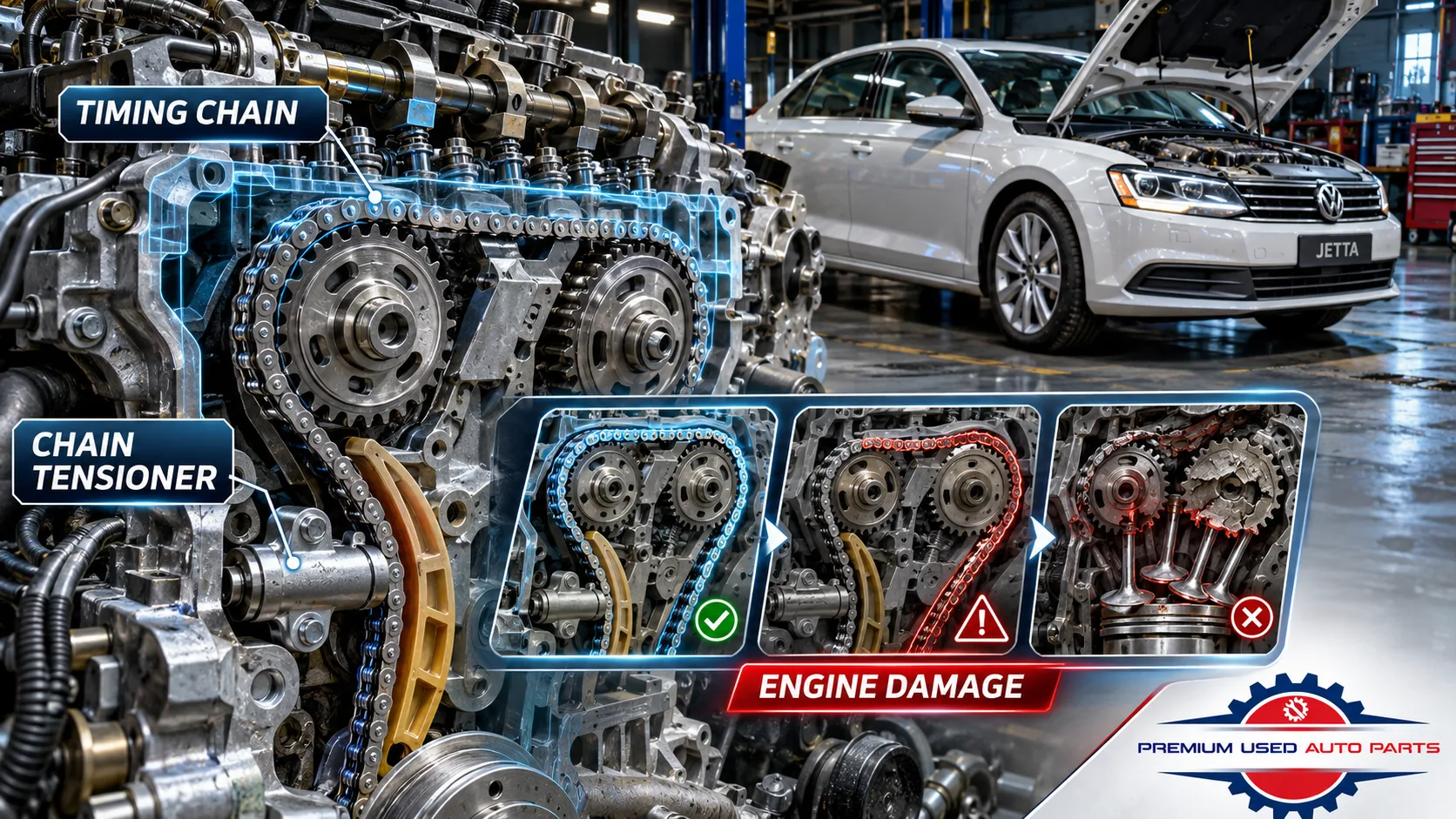
Before you approve a head job, ask for a leak-down test on every cylinder and a borescope look at the pistons. If the head quote nears 70 percent of a used engine installed, buy the engine.
Replace, Rebuild or Swap: Which Is Cheaper?
Swap it. A proper EA888 or 2.5L rebuild needs machine work, gaskets, bearings, chain parts and often pistons: $4,000 to $6,500, plus two or three weeks off the road. A tested used engine usually costs less and goes in within days.
Rebuild only if the damage stops at the head, or for a GLI or TDI you'll keep for years.
How Much Of The Bill Is Labour, and How Long Is The Car Off The Road?
Most shops book 8 to 14 hours, roughly $1,000 to $2,400 at $120 to $170 an hour. Turbo engines take longer because of the extra plumbing; TDIs take longest.
Expect 3 to 5 working days once the engine arrives, a little longer if the shop must transfer your turbo, intake or harness.
Dealer vs independent shop: how much more does a dealer charge?
A VW dealer usually charges 20 to 40 percent more for a Jetta engine replacement than an independent shop. Dealer labor often runs $170 to $230 an hour, and many dealers prefer to fit a new or remanufactured VW engine rather than one you supply.
An independent VW specialist will install a used OEM engine for the same 8 to 14 hours of labor. Use the dealer when the car is still under warranty or the repair falls under a recall.
Used, Remanufactured or New: Three Routes Priced Side By Side
How much is a new engine for a VW Jetta? For a 1.8T or 1.4T, here's how the three choices compare installed:
Used is the sensible pick for most owners. Plenty of Jettas and Golfs are written off after crashes with healthy engines, and one of those with verified mileage costs a fraction of a new one.
Is It Worth Replacing The Engine, or Selling The Jetta?
Run the numbers. A Jetta with a dead engine brings scrap money, maybe a few thousand. Spend about $4,000 on a used engine and the car is worth running-car money again.
Fix it if the body is rust-free, the transmission (especially a DSG) shifts cleanly, and the bill stays under about half the car's running value. If the gearbox is failing too, or there's structural rust, sell it as is.
Buying a Used Jetta Engine: 7 Things To Confirm First
Found a used VW Jetta engine for sale? Get these answers before you pay.
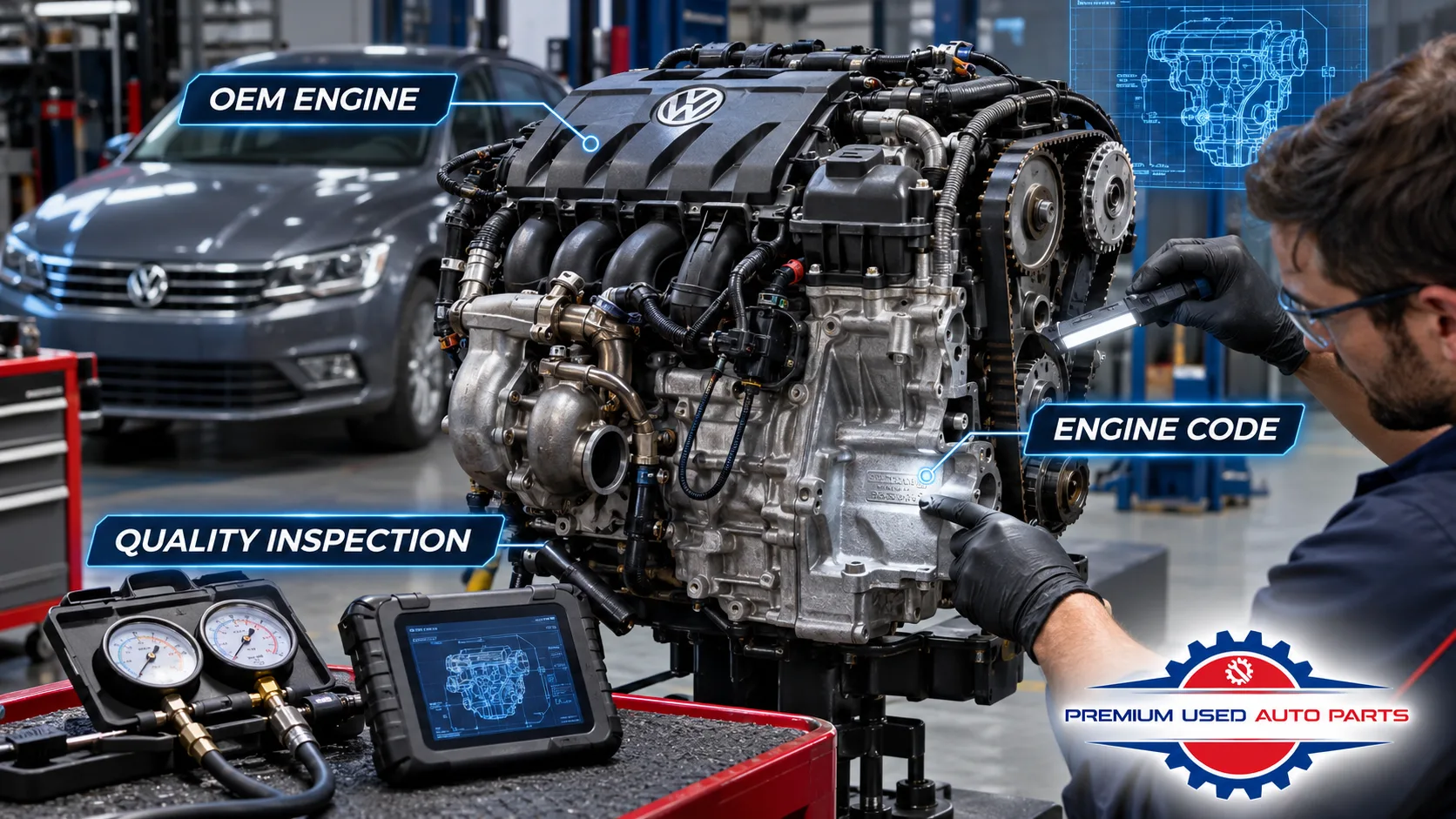
1. The engine code matches yours
Give the seller your VIN and engine code. Same-year Jettas can have different engines.
2. The donor's mileage, with proof
Ask for the donor car's VIN and odometer reading. A 1.8T with 65,000 miles is worth a lot more than one with 140,000.
3. Photos of the actual engine
Stock pictures prove nothing. Ask for the exact unit, code readable.
4. Proof it was tested
Compression or leak-down numbers are best; at minimum, proof it ran before removal. On turbo engines, ask about shaft play.
5. What's included
Bare long block, or complete with intake, turbo and harness? Labor differs for each.
6. Warranty terms in writing
Know the length and what voids it. Many require a new water pump and thermostat to install, so keep receipts.
7. Shipping, core charge and returns
Engines ship on a pallet. Ask about liftgate delivery, any core charge, and returns if the wrong one arrives.
Is the tensioner the updated part?
On a 2008 to 2014 2.0T, this check matters as much as the other seven together. VW revised the early EA888 tensioner, and you want the updated one, commonly part 06K109467K. Confirm the number for your engine code. If the seller can't say what's in there, spend $1,500 to $2,900 on a chain kit with the new tensioner before the engine goes in.
Buying a 2017 1.4T? Ask whether the donor car was part of recall 17V070 and whether the remedy was done. On any 1.4T, get compression figures on all four cylinders, and walk away from an engine with one low reading.
VW Jetta Engine FAQs
Final Words
Need a used VW Jetta engine for sale that fits the first time? Premium Used Auto Parts supplies used OEM Volkswagen engines for every Jetta generation and matches each one to your VIN before it ships. You'll see photos of the exact engine before dispatch, and eligible orders come with a 90-day warranty. Call 1-800-606-1107 with your VIN and engine code handy.
 Ford
 Chevrolet
 GMC
 Jeep
 Buick
 Cadillac
 Oldsmobile
 Tesla
 Pontiac
 Lincoln
 Dodge
 Chrysler
 Hummer
 Geo
 Mercury
 Plymouth
 RAM
 Saturn
 Audi
 BMW
 Mercedes-Benz
 Volkswagen
 Porsche
 Volvo
 SAAB
 Peugeot
 Toyota
 Honda
 Nissan
 Mitsubishi
 Mazda
 Hyundai
 Kia
 Isuzu
 Acura
 Lexus
 Subaru
 Scion
 Infiniti
 Genesis
 Land Rover
 Mini
 Bentley
 Aston Martin
 Jaguar
 Fiat
 Alfa Romeo
 Lamborghini
 Ferrari
 Maserati
 McLaren

The Premium Used Auto Parts Editorial Team is backed by years of experience in the automotive parts industry and creates practical, research-driven content for vehicle owners, repair shops, and DIY enthusiasts across the USA. Our team combines real-world parts expertise with industry research to help drivers make informed decisions about OEM replacement parts, vehicle repairs, and maintenance. Every article is developed with a commitment to accuracy, transparency, and delivering reliable information that supports smarter vehicle ownership.
 Engines
 Engines
 Engines