Lexus RX 350 Engine Replacement Cost: Used, Reman & New Prices
Table of Contents
13 ChaptersIntroduction
Your RX 350's engine is done, and the first quote probably stung. The good news: the Lexus RX 350 engine replacement cost runs lower than on most luxury SUVs, because most RX 350s share their V6 with millions of Camrys and Highlanders. Below you'll find installed prices for every model year, the checks that might put the bill on Lexus, and how to buy a used engine without getting burned.
How Much Does a Lexus RX 350 Engine Replacement Cost?
Most owners pay $3,500 to $6,000 to put a used 2GR-FE V6 into a 2007 to 2015 RX 350. A used 2GR-FKS in a 2016 to 2022 model runs $4,500 to $7,500. Go with a new engine and the bill climbs to $9,000 to $13,000.
Your model year moves the price more than anything else. It decides which engine you need, and how many donor engines are sitting in salvage yards.
Installed totals assume typical independent-shop labor of $1,700 to $2,400, plus $300 to $500 for oil, coolant, filters and gaskets. All-wheel drive and big-city shop rates push you toward the top of each range. These are our estimates of U.S. pricing as of October 2026, not quotes. For a real number on your RX, send us the VIN.
Check Recalls and Warranty Before You Pay For Anything
Ten minutes on the phone can be worth thousands. Do this before a shop quotes you.
2023 to 2026 RX 350: start at the dealer
Lexus covers the powertrain for 6 years or 70,000 miles. If the 2.4L turbo in your 2023 RX failed at 50,000 miles, it's very likely Lexus's bill. Bring your oil-change receipts, because that's the first thing the service advisor will ask for.
2007 to 2009 RX 350: the VVT-i oil hose
This short hose feeds oil to the variable valve timing on early 2GR-FE engines. Part of it is rubber, and over time that rubber can develop a pinhole. Once it leaks, oil sprays out under full pressure. You'll hear abnormal engine noise, the oil pressure light comes on, and the pan can run dry fast.
Lexus fixed it for free under Limited Service Campaign 9LH. The campaign covered certain 2007 to 2009 RX 350s and 2007 to 2008 ES 350s. When Lexus extended it in August 2014, roughly 30,000 vehicles still hadn't been done. That extension ran out on December 31, 2021.
So if your RX still has the original hose, you're paying for this one yourself. It's still the cheapest insurance you'll ever buy. The Lexus kit is part number 04009-33131. You'll also see this hose called the "oil cooler line," even in some Lexus labor codes. Ask for the VVT-i oil hose by name, though, because the 2GR has other oil lines that leak for unrelated reasons.
Already lost the engine to a burst hose? Ask a Lexus dealer to pull the campaign history on your VIN. If 9LH was never performed, a goodwill request is worth a try, though nothing is guaranteed.
How to check your VIN
- Run the 17-digit VIN through the free NHTSA recall lookup.
- Call a Lexus service desk anyway. NHTSA's tool shows safety recalls, and service campaigns like 9LH often won't appear there.
- Ask about three things: open recalls, service campaigns and warranty enhancements.
Hybrid owners have their own campaign to ask about. Lexus also ran one on the oil cooler pipe of certain 2016 to 2019 RX 450h models.
Is The Engine Actually Dead? Rule These Out First
Plenty of RX 350 engines get condemned that didn't need to be. Spend $150 confirming the diagnosis before you spend $5,000 on a replacement.
Signs the engine really is done:
- A deep knock from the bottom end that gets faster as the revs climb. That's usually a rod bearing.
- Low compression on one or more cylinders that a leak-down test traces to rings or valves.
- Milky oil, or coolant disappearing with white smoke out the tailpipe, which points to a head gasket or a cracked head.
- Metal glitter in the drained oil or the cut-open filter.
- The engine kept running after the oil light came on, and it's been noisy ever since.
Problems that sound worse than they are:
- A one-second rattle on a cold start. Many 2GR engines do this when the VVT-i cam gear wears. It's irritating, but it isn't terminal. Replacing the actuator usually fixes it.
- Ticking at idle. A cracked exhaust manifold or a leaking gasket can sound like a valve train problem.
- Overheating. A weeping water pump can cook the heads if you ignore it, but caught early it's a pump job, not an engine job.
- Harsh or slipping shifts. Transmission trouble often gets blamed on the engine. Scan for transmission codes before anyone pulls anything.
One more case worth knowing. If the VVT-i hose bursts and you shut the engine off within seconds, the engine may be fine. A new hose, fresh oil and a careful listen could be the whole repair.
Tests to ask for: a compression test plus a leak-down test, which most shops run for $100 to $250. A borescope look at the cylinder walls is cheap too. For a cheap second opinion, a lab oil analysis kit (about $40) will show bearing metal.
Which Engine Is In Your RX 350, and What Will Swap In?
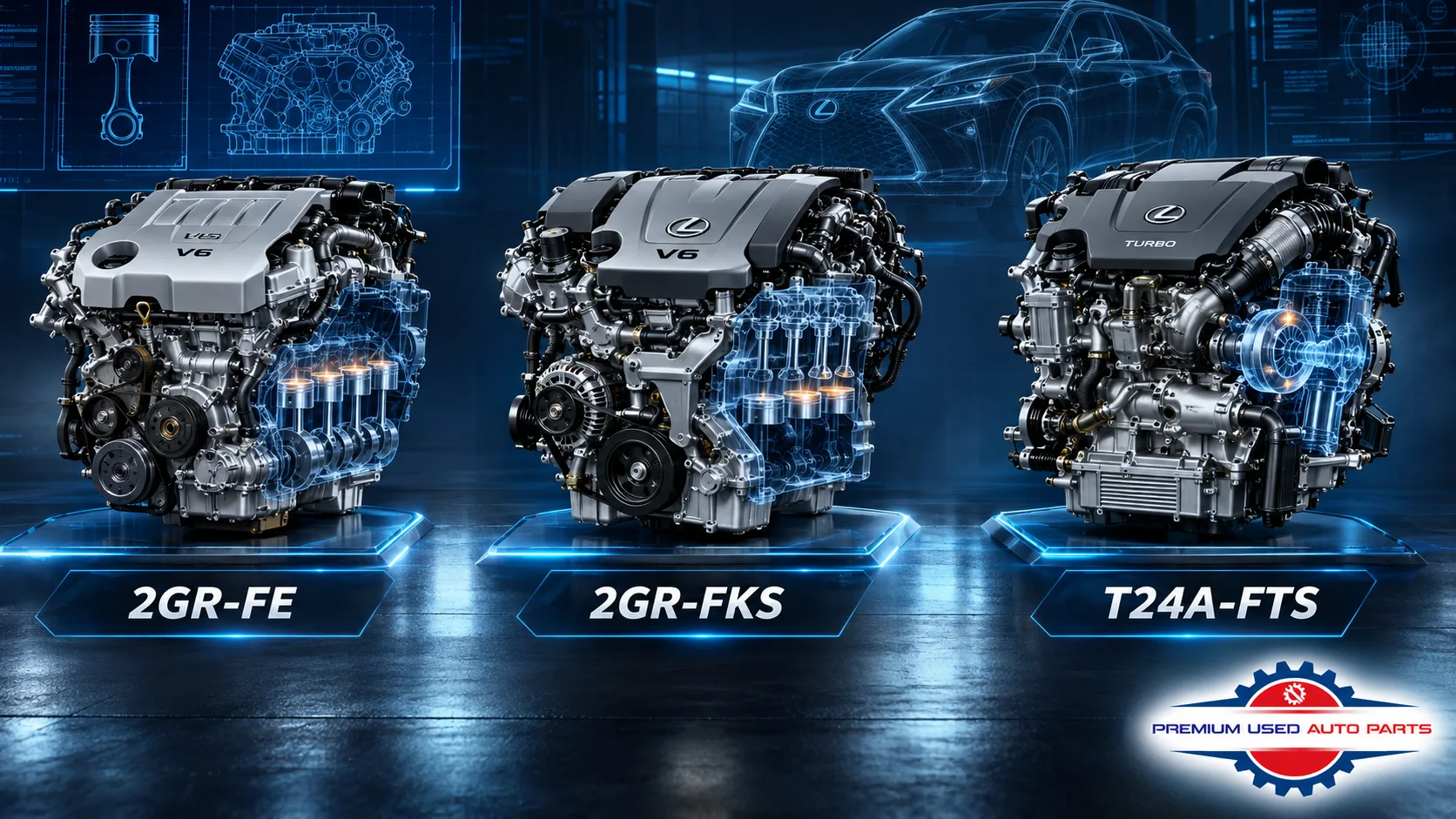
Start with the model year, then confirm it with the engine code on the block. This matters more than most people expect. A 2GR-FE and a 2GR-FKS are both 3.5-liter V6s, and they look almost identical sitting on a pallet. They still won't trade places.
3.5L 2GR-FE (2007–2015)
The engine in the second- and third-generation RX 350. Port injection, a timing chain rather than a belt, and a reputation for lasting when the oil gets changed on time. It's also the cheapest engine here to replace, because Toyota built so many.
3.5L 2GR-FKS (2016–2022)
The fourth-generation RX 350 and the three-row RX 350L (2018 to 2022) got the FKS. Toyota added direct injection alongside the port injectors and reworked the engine management. Same displacement as the FE. To your wiring harness and computer, though, it's a different engine.
2.4L T24A turbo (2023 onward)
For 2023, Lexus replaced the V6 with a 2.4L turbocharged four. Used ones are still scarce.
Can a Camry or Highlander engine go in an RX?
Often, yes. Lexus is Toyota's luxury brand, launched in 1989, and the 2GR went into a lot of Toyotas. You'll find it in the Camry V6, Highlander, Sienna, Avalon and the Lexus ES 350. That supply is why RX engines cost less than you'd expect from a luxury badge.
The rule is simple: match the version. A 2GR-FE donor fits a 2007 to 2015 RX, and a 2GR-FKS donor fits a 2016 to 2022. The long block is shared, but the oil pan, intake manifold, mounts and accessory brackets can differ. A good shop moves your RX's own parts onto the donor. Confirm that before you order. If you live in California, read the smog note in the buying checklist below first.
Hybrid RX engines are a separate job
| Model | Years | Engine |
|---|---|---|
| RX 400h | 2006–2008 | 3.3L 3MZ-FE V6 |
| RX 450h | 2010–2015 | 3.5L 2GR-FXE V6 |
| RX 450h / RX 450hL | 2016–2022 | 3.5L 2GR-FXS V6 |
| RX 350h, RX 450h+ | 2023–2026 | 2.5L A25A-FXS four |
| RX 500h | 2023–2026 | 2.4L T24A-FTS turbo four, hybrid-integrated |
None of the hybrid engines will run a gas RX 350, and the reverse is true too. The RX 500h shares the T24A code with the RX 350, but it's tied into a hybrid system, so treat it as its own job.
Used, Rebuilt, Remanufactured or New: Which Route Fits
For most RX 350s, a used engine wins. It costs the least and has you driving again soonest. The other three routes make sense in narrower cases.
Rebuilds look competitive on paper, but the quote often grows once the machine shop measures the block and crank. Meanwhile your SUV sits.
Used engines have a quiet advantage. Many of the best donors come out of RXs, Camrys and Highlanders written off after a collision. The engine was never the problem in those cars. Pair one with documented mileage and a written warranty, and it's hard to beat on value.
Labor: Shop Hours, How The Swap Is Done, Dealer Vs Independent
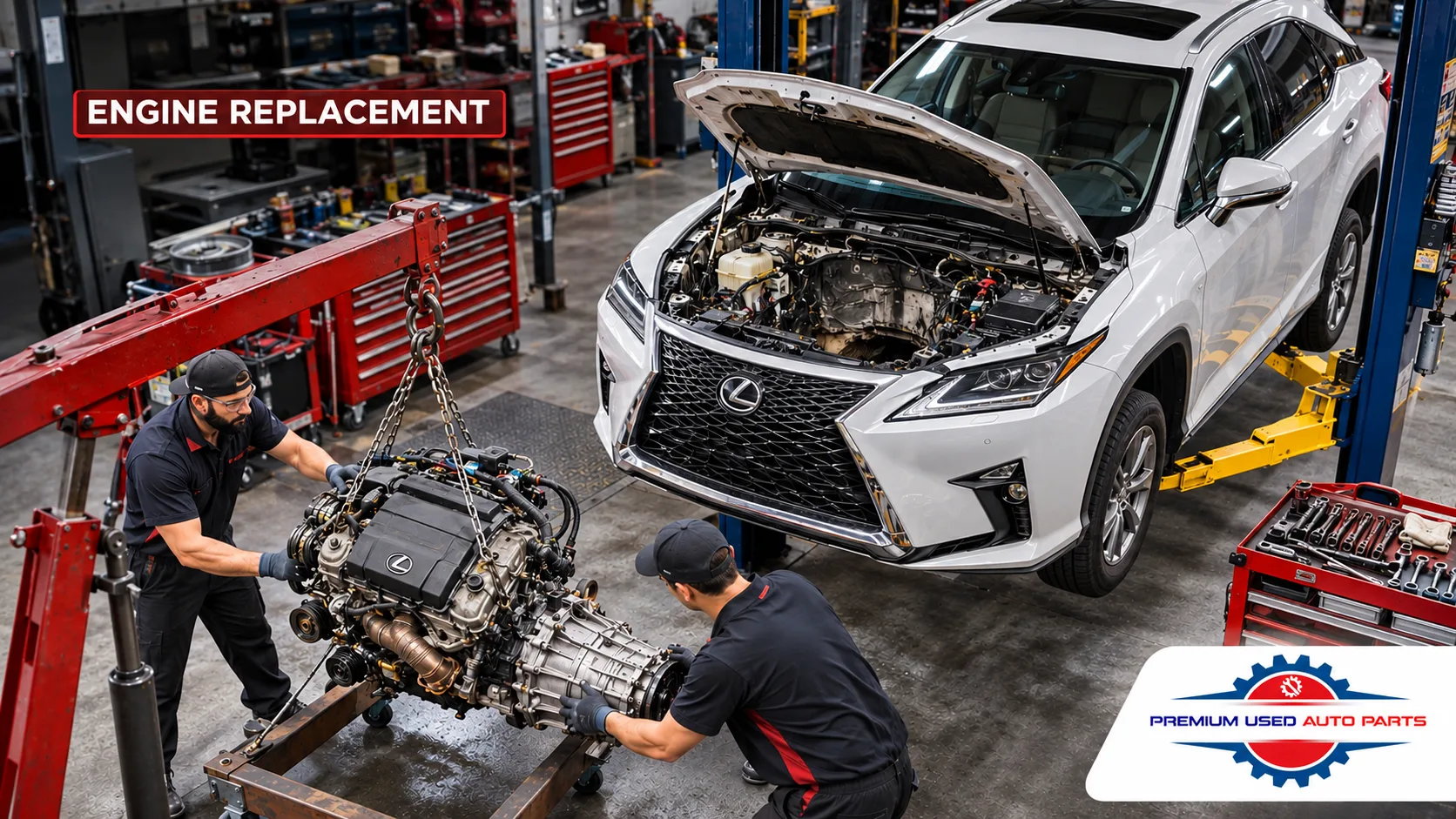
An RX 350 engine swap takes 12 to 18 shop hours. At independent rates of $120 to $160 an hour, that's roughly $1,450 to $2,900 in labor.
Why so many hours? On most RX 350s, the shop lowers the engine and transaxle out the bottom together, still bolted to the front subframe. That means disconnecting the axles, steering, exhaust and cooling lines first, then reversing all of it. All-wheel-drive models add the transfer unit and rear driveshaft to the list, which is why they land at the high end.
Budget another $300 to $500 for oil, coolant, filters and gaskets, plus motor mounts if yours are cracked. With the engine already on site, most shops hand back the keys in 3 to 5 working days. A seized exhaust stud or a backordered gasket can add a few more.
Dealer vs independent. Lexus dealer labor often runs $180 to $250 an hour in metro areas. Many dealers also won't install a used engine you bring in, so you end up paying for a new or remanufactured one. Put those together and a dealer engine replacement commonly lands between $10,000 and $14,000. An independent shop that knows Toyota V6s can do the same job with a used engine for roughly half of that.
Fix the RX or Sell It?
Most of the time, fix it. RX 350s hold their value, and an SUV with a blown engine sells for a fraction of a running one. Wholesalers price non-runners for the worst case.
Run your own numbers. Say your RX is worth $9,000 running and $3,000 with a dead engine. A $4,500 swap closes that $6,000 gap and leaves you with a known engine.
200,000 miles on the clock? Look at the rest of the SUV, not the odometer. A rust-free body, a transmission that shifts cleanly and an interior in decent shape all say fix it. A donor with 60,000 to 100,000 miles can buy that RX years of service.
Walk away when:
- The transmission is slipping as well.
- There's rust in the frame rails or subframe mounts.
- The repair would eat more than half of what the RX is worth running.
Buying a Used RX 350 Engine: 8 Things To Confirm
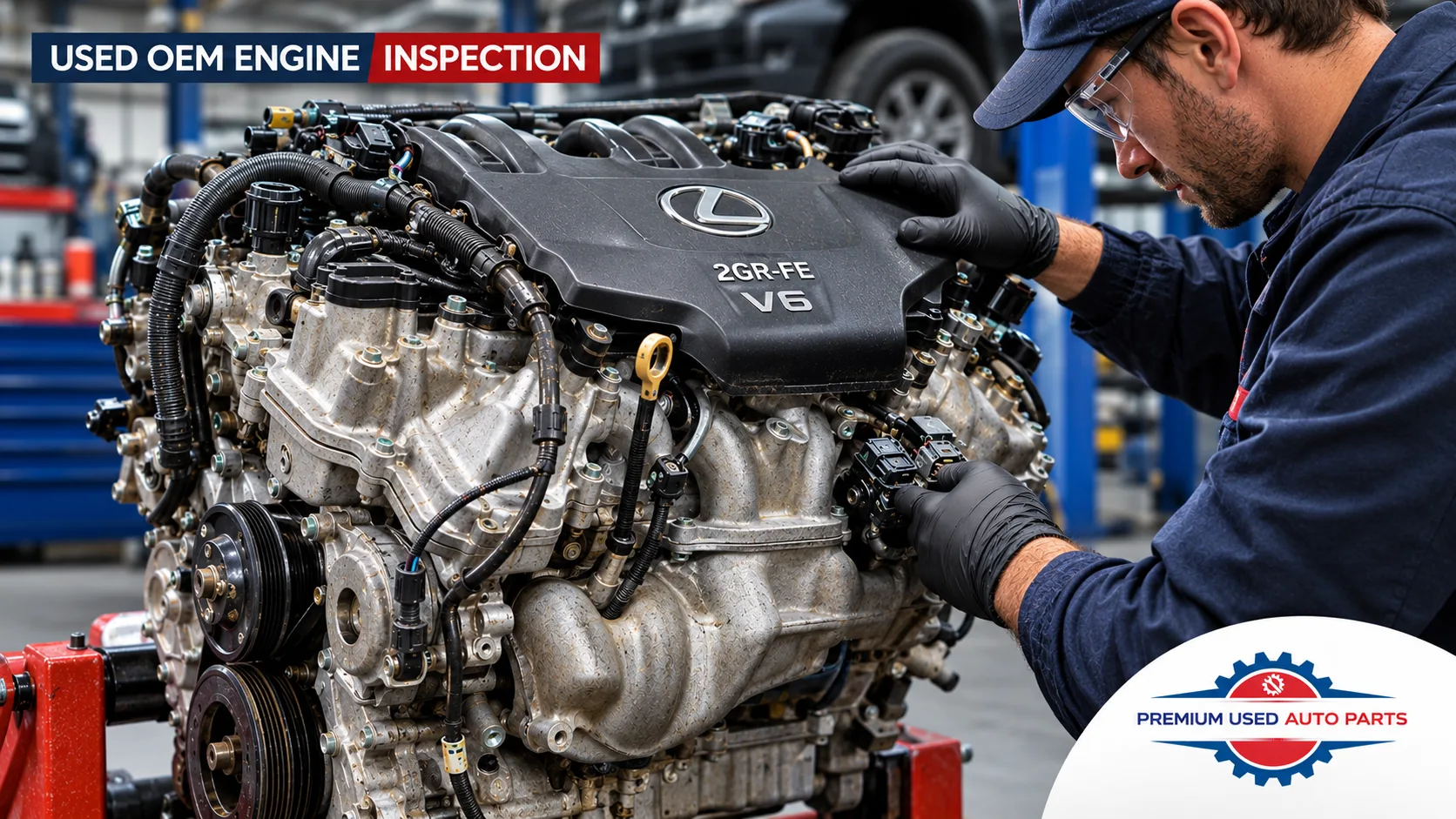
Shopping for a used Lexus RX 350 engine for sale? Get these answered before any money changes hands.
- A VIN match. Send the seller your full VIN, not just the year. It settles FE, FKS or T24A with no guessing.
- The donor's mileage, with proof. Ask for the donor vehicle's VIN and odometer reading. An engine with 70,000 miles is worth more than one with 150,000, and the price should show it.
- Photos of the actual engine. You want the unit you'll receive, engine code visible, not a catalog shot.
- A test record. Was it run before it was pulled? Compression numbers or a video of it running both beat a promise.
- The VVT-i hose, on 2GR-FE donors. Toyota donors count too. Same-era Camry, Avalon, Sienna, Highlander and RAV4 engines used the same hose, covered by Toyota campaign 90K. Ask whether the donor's hose was updated. If nobody knows, fit a new one before the first start.
- What's in the crate? A bare long block and a dressed engine with intake, sensors and accessories are very different buys. Your shop needs to know which is coming to quote labor.
- Warranty, shipping and core in writing. Read what voids the warranty. Many sellers require receipts for new oil, coolant and filters, and some want a new water pump and thermostat too. Engines ship by freight, usually $150 to $400 and 3 to 7 business days. A business address or a liftgate request keeps it simple. Ask whether there's a core charge and how long you have to return the old engine.
- Smog rules if you're in California. Any engine that differs from the one your RX shipped with counts as an "engine change" in California. It must come from the same model year or newer, and the car has to pass a Smog Check Referee inspection before it can go back to a normal station. The clean path is a same-code engine from an RX of the same year or newer. If the donor came from another Toyota, call the referee line before you buy.
Do These Jobs While the Engine Is Out
With the old engine out, everything around it is easy to reach. Use that.
- Water pump: a weeping 2GR water pump is among the most common RX 350 repairs. Do it now and you won't pay for the labor twice. See Lexus RX 350 water pump replacement.
- Timing cover: oil seeping from the timing chain cover is a well-known 2GR complaint. Reseal it before the new engine goes in.
- Transmission: Still not sure the transmission is healthy? Have it checked now, before the new engine goes in.
After the Swap: the First 1,000 Miles
A same-code swap normally needs no reprogramming, because your RX keeps its own ECU and key immobilizer. What you do in the first few weeks decides whether a warranty claim, if you ever need one, holds up.
- Change the oil and filter at 500 to 1,000 miles. It flushes out anything left over from storage and installation.
- Watch the coolant level for the first week. Air pockets work their way out, and the reservoir can drop. Top it up cold.
- Check for leaks after the first few drives, especially at the oil filter housing, the coolant hoses and wherever the shop moved parts from your old engine.
- Finish a full drive cycle before a smog check. Clearing codes resets the readiness monitors, and a car that isn't ready won't pass. A week of mixed city and highway driving usually does it.
- Keep every receipt for fluids, filters and parts in one folder. That's what a used-engine warranty claim runs on.
Lexus RX 350 Engine FAQs
Get a VIN-Matched RX 350 Engine
Need a 2GR-FE or 2GR-FKS for your RX 350? Premium Used Auto Parts sources used OEM engines and matches each one to your VIN before it ships. You'll see photos of the engine you're actually getting, and eligible orders carry a 90-day warranty. Call 1-800-606-1107 with your VIN handy.
 Ford
 Chevrolet
 GMC
 Jeep
 Buick
 Cadillac
 Oldsmobile
 Tesla
 Pontiac
 Lincoln
 Dodge
 Chrysler
 Hummer
 Geo
 Mercury
 Plymouth
 RAM
 Saturn
 Audi
 BMW
 Mercedes-Benz
 Volkswagen
 Porsche
 Volvo
 SAAB
 Peugeot
 Toyota
 Honda
 Nissan
 Mitsubishi
 Mazda
 Hyundai
 Kia
 Isuzu
 Acura
 Lexus
 Subaru
 Scion
 Infiniti
 Genesis
 Land Rover
 Mini
 Bentley
 Aston Martin
 Jaguar
 Fiat
 Alfa Romeo
 Lamborghini
 Ferrari
 Maserati
 McLaren

The Premium Used Auto Parts Editorial Team is backed by years of experience in the automotive parts industry and creates practical, research-driven content for vehicle owners, repair shops, and DIY enthusiasts across the USA. Our team combines real-world parts expertise with industry research to help drivers make informed decisions about OEM replacement parts, vehicle repairs, and maintenance. Every article is developed with a commitment to accuracy, transparency, and delivering reliable information that supports smarter vehicle ownership.
 Engines
 Engines
 Engines