Are Used Airbags Worth It? What Every Driver Should Know in 2026
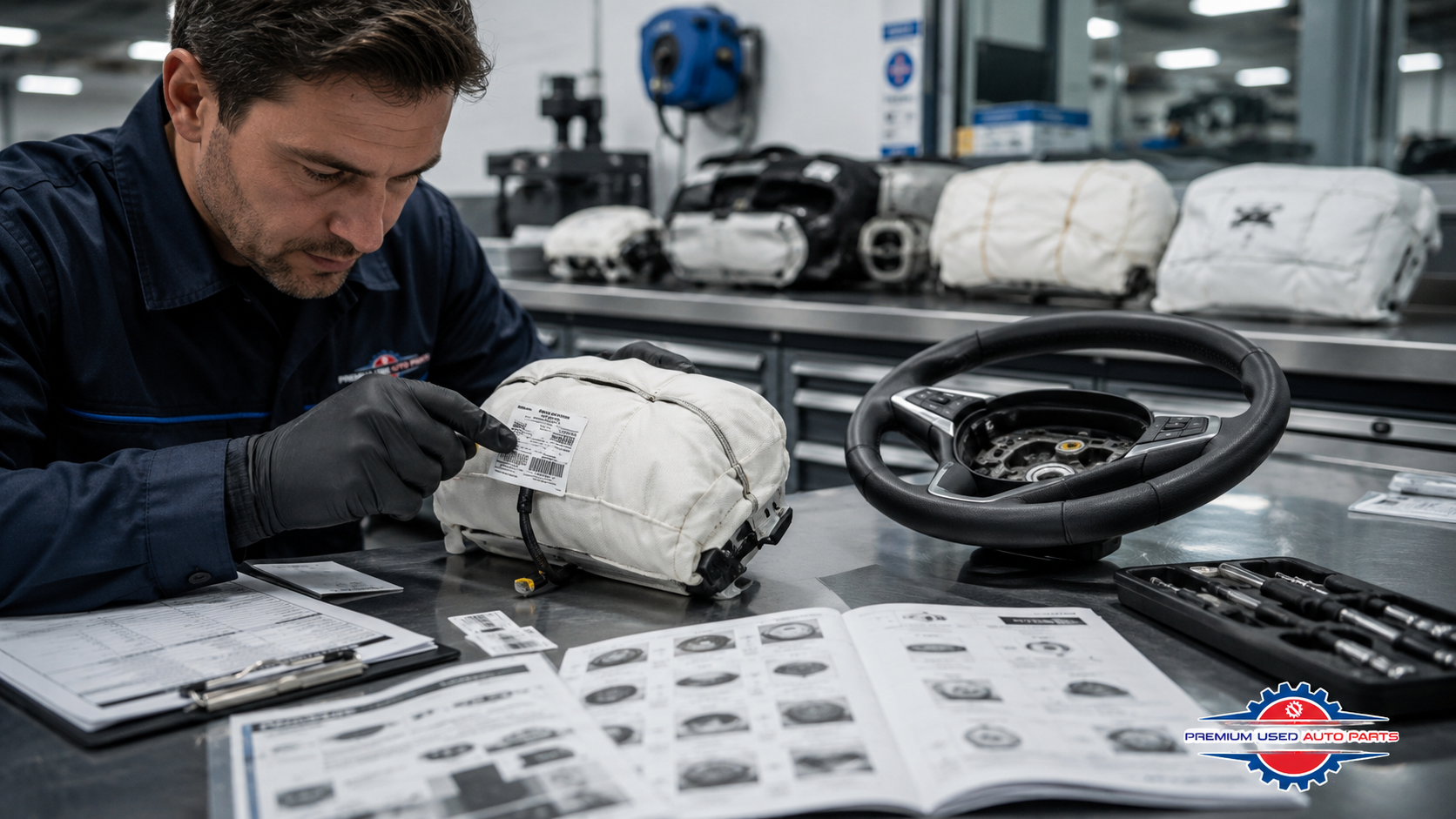
Table of Contents
12 ChaptersIntroduction
Are used airbags worth buying in 2026? Yes — when the unit has never deployed, matches your exact part number and airbag position, comes from a Takata recall-free donor vehicle, and is installed with a proper SRS module reset. Fail any one condition and it's not safe at any price. This guide shows where that line sits, California replacement costs, and what to verify before buying.
SRS Airbags Explained
SRS stands for Supplemental Restraint System — the network of crash sensors, control module, seat belt pretensioners, and airbags that work together in a collision. Every airbag in a modern car is part of the SRS; there is no separate "standard" airbag. "Supplemental" is important to remember since airbags work together with your seat belt.
On your dashboard, your SRS indicator should illuminate for a second at startup before shutting off. If it stays lit, the system has logged a fault — and in many vehicles the airbags are disabled and won't deploy until it's fixed.
Inside an Airbag Deployment
Crash sensors detect severe deceleration and signal the SRS control module. The module fires an igniter inside the inflator — a sealed canister of solid propellant that instantly converts to harmless nitrogen gas. The bag inflates in roughly 30-50 milliseconds, then vents.
Can the airbag itself cause harm? Early single-stage inflators deployed at full force every time, which could injure smaller or out-of-position occupants. Modern multi-stage (adaptive) inflators adjust deployment force based on crash severity, occupant weight, and seat belt use — one more reason exact part matching matters.
The Airbags Hiding in Your Car
Most of the contemporary cars have from 6 to 10 airbags, including one for the driver in the steering wheel, another for the passenger in the dashboard, side airbags in the front seats, curtain airbags in the roof rails, as well as knee and center airbags.
Two types of airbags that people often get confused with are side and curtain airbags. Side airbags protect the chest and torso by deploying from the seat side, while curtain ones drop from the roof rail and protect your head along the window area.
The Line Between a Safe and Unsafe Used Airbag
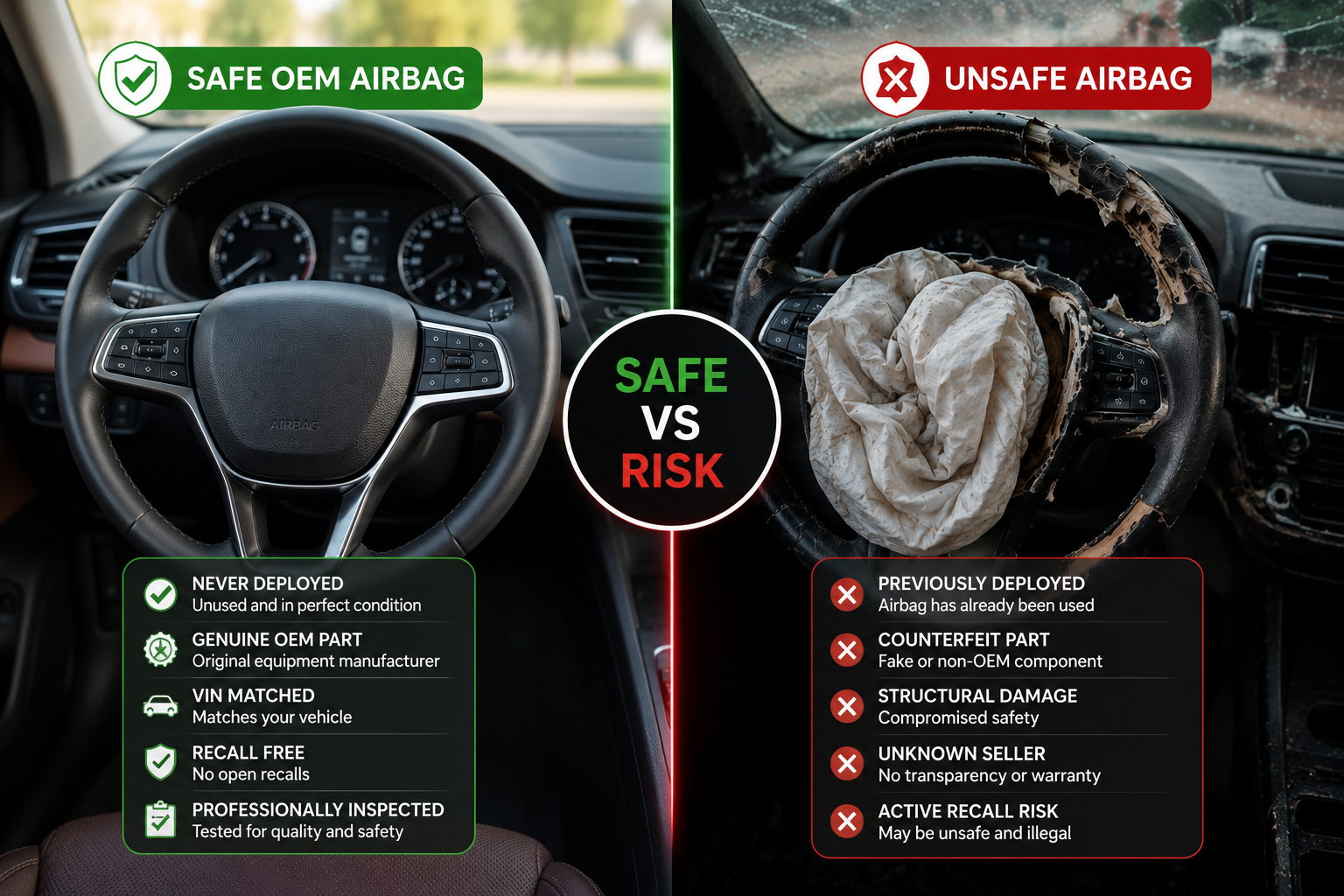
A used airbag is safe when four things are true: the inflator has never fired, the part number matches your vehicle and position exactly, the donor vehicle is clear of inflator recalls, and the SRS module is reset at installation. It is not safe if the unit was ever deployed, shows moisture or heat damage, has a tampered cover, or comes from a recalled donor — no exceptions.
Where NHTSA and IIHS Stand on Salvage Airbags
Safety authorities urge caution. IIHS recommends a new module when possible and advises using a salvaged airbag only if it's been inspected and certified, with donor VIN documentation. NHTSA's strongest warnings target counterfeit airbags, which have malfunctioned in testing. Both point to one solution — buy from a seller who documents its inspection process instead of claiming "tested."
Proving an airbag was never deployed
A genuine undeployed unit has an intact inflator housing with no burn residue, factory folds preserved under an uncut cover, undamaged connectors, and a part number that validates against the donor VIN. A proper seller confirms this through physical and diagnostic inspection.
SRS Light Still On After Replacement? Here's Why
After any deployment, the SRS control module stores crash data and hard codes, locking itself until it's professionally reset or replaced. A standard OBD2 scanner cannot erase these codes — which is why the light stays on even after a correct installation.
The fix depends on the module's condition. If it isn't physically damaged, a reset ($50–$150) restores it to factory condition, plug-and-play afterward. A replacement runs $300–$800+ and usually needs dealer programming. Reset first; replace only when the unit is burned, cracked, or water-damaged.
Airbag Replacement Costs in California
The realistic math for California drivers:
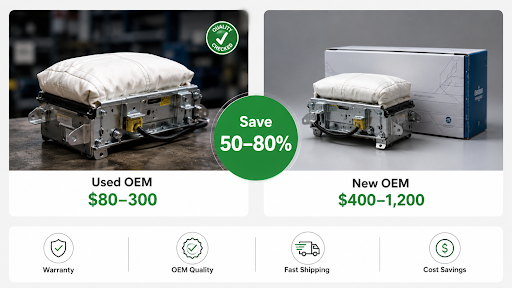
- Used OEM airbag: $80–$300 per position
- New OEM airbag: $400–$1,200 per position
- SRS module reset: $50–$150
- Labor: roughly 1–3 hours per position at typical California shop rates
Position for position, a verified used OEM airbag typically saves 50–80% versus new. On a multi-airbag deployment — driver, passenger, and curtains together — that difference can reach $1,500–$3,000.
Why deployed airbags can total your car
It happens constantly. Insurers total a vehicle when repair costs exceed a percentage of its value, and several deployed airbags at dealership prices can push an older car past that line. Used OEM airbags in Calforina are often what makes repairing — rather than scrapping — a mechanically sound vehicle possible.
Used, New, or Aftermarket: Making the Right Pick
New OEM offers maximum assurance at maximum price. Used OEM is the same factory part, verified undeployed, at a fraction of the cost. Aftermarket is where airbags differ from other parts: there's no legitimate generic airbag market, and cheap non-OEM units sold online are frequently counterfeit. For airbags, the real choice is new OEM or inspected used OEM.
Counterfeits do leave clues. Warning signs include vinyl texture that doesn't match factory trim, missing tear seams on the cover, evidence of trimming or re-gluing, prices far below market, and no donor documentation. If any appear, walk away.
The Truth About Airbag Expiry
Modern airbags are designed to last the vehicle's life, with no scheduled replacement — the inflator is a sealed unit whose chemistry stays stable for decades. The exception is recalled inflators (most famously Takata), where the propellant degrades over time. An airbag's age matters far less than its recall status and condition.
Before You Buy a Used Airbag Online
Start with the Takata recall check: ask for the donor VIN and run it through the NHTSA.gov recall lookup before you pay. If a seller won't share the donor VIN, that's your answer.
Then confirm the inspection. A credible one verifies deployment status, inflator housing integrity, connector and wiring condition, and part number validation against your vehicle — documented, not just promised.
Your 6-Point Pre-Purchase Checklist
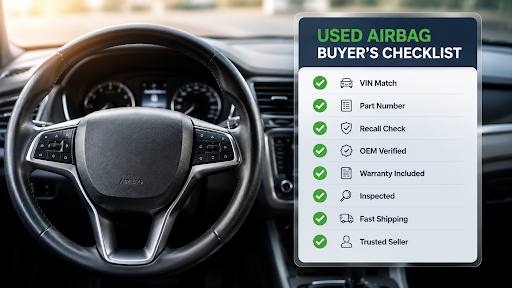
- VIN and part-number match confirmed — not just year/make/model
- Deployment status physically verified
- Donor vehicle documented (VIN, mileage, recall-clear)
- Written warranty included
- Tracked, nationwide shipping
- A real support team you can reach after delivery
Premium Used Auto Parts checks all six on every airbag — VIN-matched to your exact vehicle, inspected before shipping, and backed by a 30-day warranty with tracked delivery. Get your VIN-matched quote today.
FAQs
Conclusion
Smart savings or safety risk? The verification decides. Undeployed, VIN-matched, recall-checked, inspected, and installed with an SRS reset, a used airbag is the same factory part at 50–80% less. Skip any of those steps, and no discount is worth it. Demand documentation before you pay — and if a seller can't show its process, keep looking. Your airbag only gets one chance to work.

 Ford
Ford Chevrolet
 GMC
GMC Jeep
Jeep Buick
Buick Cadillac
 Oldsmobile
 Tesla
Tesla Pontiac
 Lincoln
 Dodge
Dodge Chrysler
 Hummer
 Geo
Geo Mercury
 Plymouth
 RAM
RAM Saturn
 Audi
Audi BMW
BMW Mercedes-Benz
 Volkswagen
 Porsche
 Volvo
Volvo SAAB
SAAB Peugeot
 Toyota
 Honda
Honda Nissan
 Mitsubishi
 Mazda
Mazda Hyundai
 Kia
Kia Isuzu
Isuzu Acura
Acura Lexus
Lexus Subaru
 Scion
Scion Infiniti
 Genesis
 Land Rover
 Mini
Mini Bentley
 Aston Martin
 Jaguar
 Fiat
Fiat Alfa Romeo
 Lamborghini
 Ferrari
 Maserati
 McLaren
The Premium Used Auto Parts Editorial Team is backed by years of experience in the automotive parts industry and creates practical, research-driven content for vehicle owners, repair shops, and DIY enthusiasts across the USA. Our team combines real-world parts expertise with industry research to help drivers make informed decisions about OEM replacement parts, vehicle repairs, and maintenance. Every article is developed with a commitment to accuracy, transparency, and delivering reliable information that supports smarter vehicle ownership.