GMC Sierra Engine Replacement Cost: 2026 Price Guide
Table of Contents
12 ChaptersGMC Sierra Engine Replacement Cost At a Glance
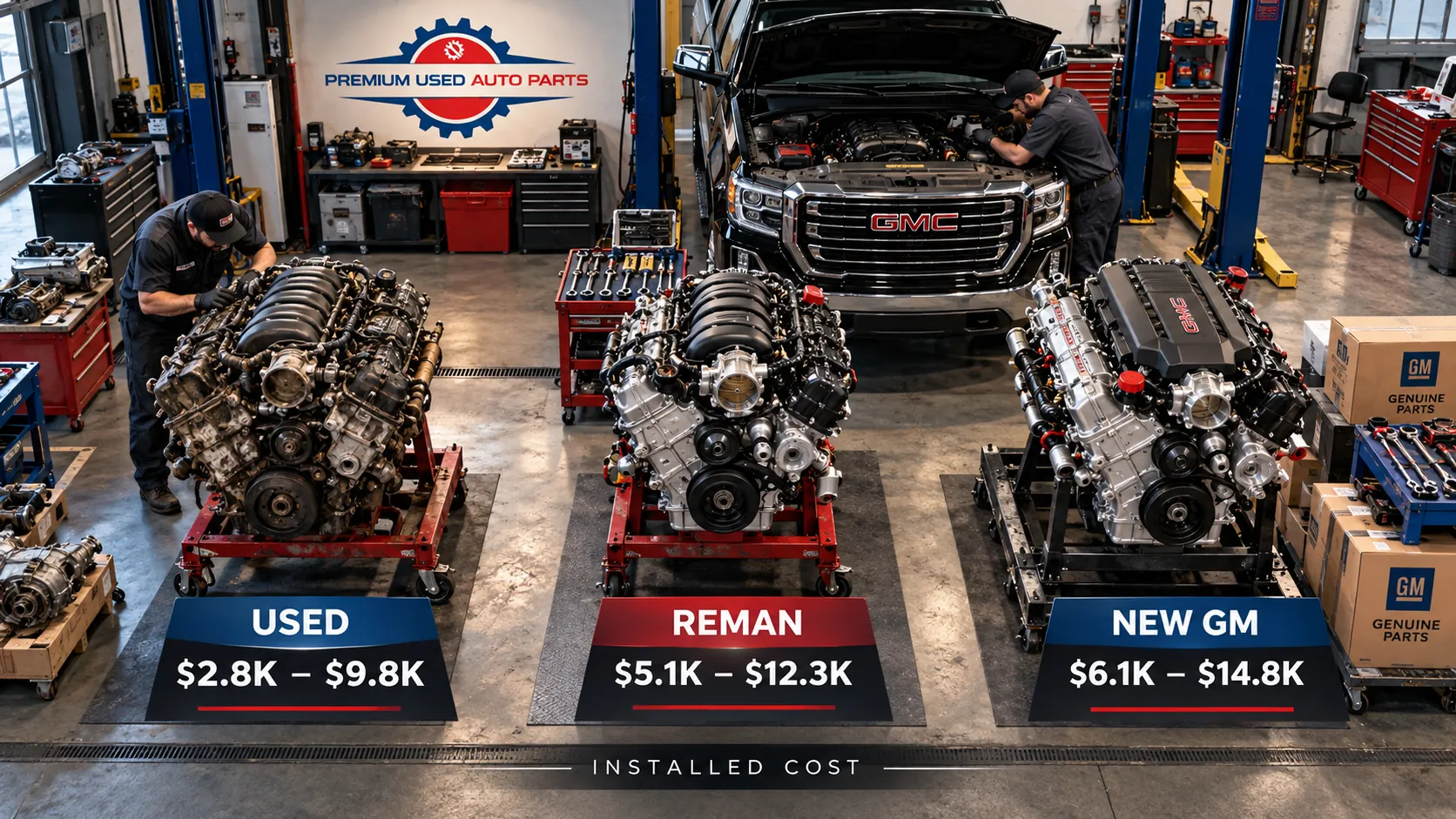
Quick answer: Expect to pay $2,800 to $9,800 to replace a GMC Sierra gas engine with a used unit, $5,100 to $12,300 for a remanufactured one, and $6,100 to $14,800 for a new GM engine, fitted. The 5.3L lands mid-range; the 6.2L costs most. If your Sierra is dealing with a lifter problem, a worn-out engine, or a complete engine failure, knowing your options can help you avoid spending more than you need to. Premium Used Auto Parts can help you find a quality used OEM replacement engine that fits your GMC Sierra.
Your final bill depends on three things: which engine your Sierra has, whether you go for used, remanufactured or new, and your shop's hourly rate. The numbers below use US independent-shop rates of $110–$180 an hour, and each installed total allows $400–$700 for gaskets, fluids, an oil cooler flush and the small parts that always get replaced. Dealers usually charge more.
Which Sierras are Affected: 2021–2024 Sierra 1500 with the L87 (Recall 25V274)
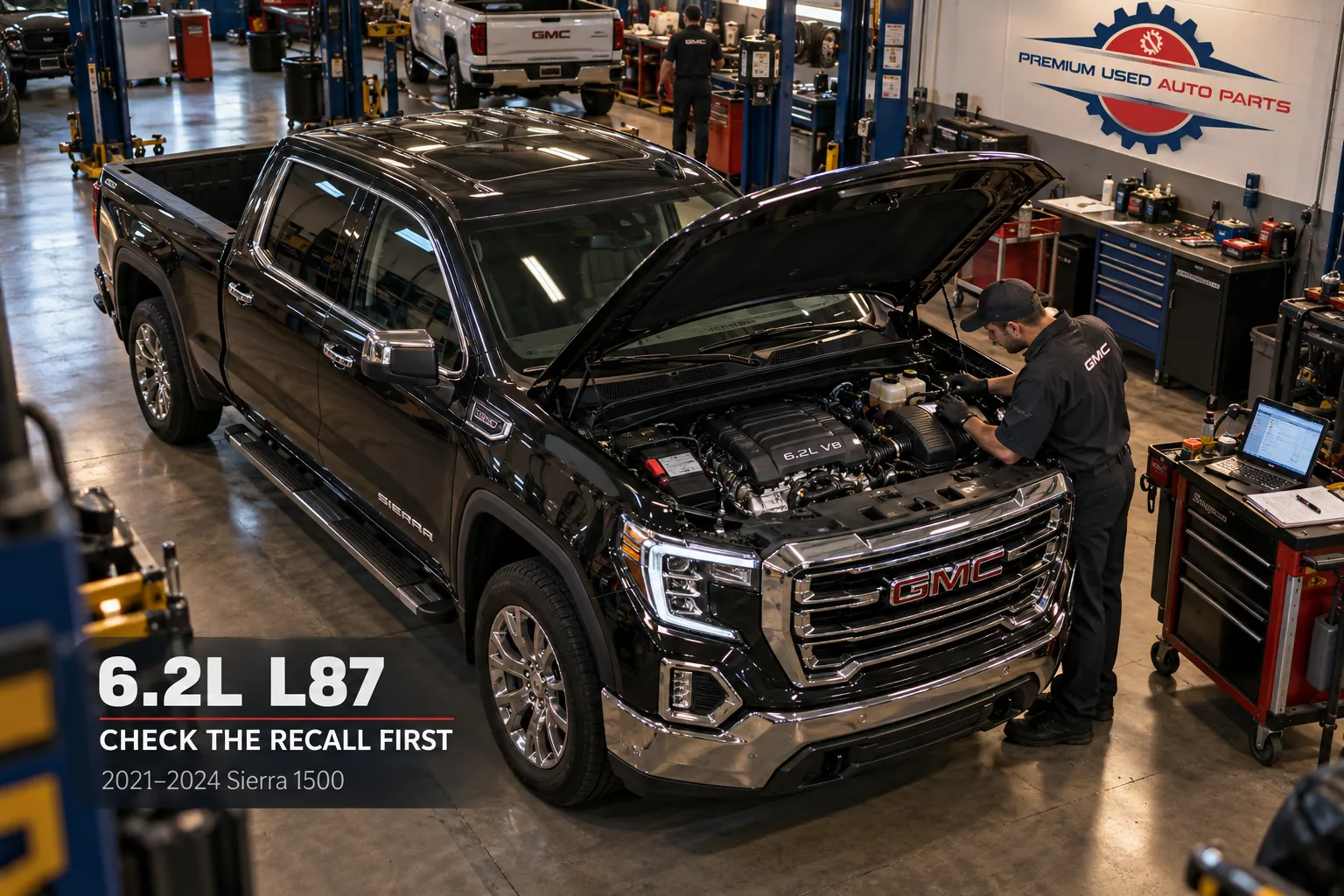
Recall 25V274 covers 2021–2024 Sierra 1500 pickups fitted with the 6.2L L87 gas V8. The same engine is also recalled in the Silverado 1500, Tahoe, Suburban, Yukon and Escalade, about 597,571 vehicles in total. The fault is engine damage that can lead to a sudden loss of power while driving.
Pass Vs Fail: New Engine, or 0W-40 Oil and a New Cap
The recall starts with an engine inspection, and what happens next depends on the result.
| Inspection result | What happens | Cost to you |
|---|---|---|
| Pass | The engine is switched to thicker 0W-40 oil, with a new oil fill cap showing the new grade, a new oil filter and an owner's manual insert | Nothing |
| Fail | The engine is repaired or replaced | Nothing |
If your truck passed, every oil change from then on needs 0W-40 oil that meets GM's dexos R spec, because that's what the new cap calls for.
A 6.2 that passed and got 0W-40 is safer, but not guaranteed. Passing the inspection lowers the risk, but some engines have still failed afterwards. Keep using the correct oil, keep every receipt and treat any knock, warning light or hesitation as urgent.
Post-Remedy Failures: NHTSA's Expanded Investigation (Aug 2026)
The fix hasn't ended the story. In January 2026, federal safety regulators at NHTSA began looking into whether the recall remedy was working, after owners reported failures following both the oil change and full engine replacements. On August 20, 2026, that became a formal engineering analysis covering about 997,743 2021–2026 trucks and SUVs with the L87, including the Sierra 1500.
The numbers behind it are striking. NHTSA logged 499 owner complaints of engine failure after the remedy, GM reported 6,953 of its own, and 191 more failures involved engines built after the original recall window. Of those 499 complaints, 473 followed the oil change and 26 followed a full engine replacement. As of August 31, 2026, the investigation was still open with no new recall announced.
This matters if your replacement engine failed again. It's a known pattern, it's under federal investigation, and you shouldn't pay for it yourself without pushing back first.
How To Check Your VIN And Log Records For A Warranty Or Lemon Claim
Enter your 17-digit VIN on GM's recall lookup or at nhtsa.gov/recalls to see whether recall 25V274 is open on your truck. Then keep a folder with:
- The recall notice letter and campaign number
- The dealer repair order showing the inspection result, the 0W-40 oil change or any engine repair or replacement
- Oil change receipts showing dexos R 0W-40 oil, which prove maintenance if a claim is disputed
- A dated record of every knock, warning light or hesitation, which supports a warranty or lemon-law claim if the engine fails again
How To Tell Which Engine Is In Your Sierra
Pin this down before you call a single seller. The engine code decides the price, the fault you're most likely facing and which used engines will actually bolt in. If you're looking for replacement parts for another GMC model, take a look at our GMC used auto parts to find the right part for your vehicle.
5.3L L83 / L84 / LMG (AFM and DFM)
The 5.3L V8 is the engine in most Sierra 1500s. The 2014–2018 trucks use the L83, which has Active Fuel Management (AFM): it shuts down four cylinders on a light throttle to save fuel. From 2019, most Sierras use the L84 with Dynamic Fuel Management (DFM), which can switch off cylinders in many more combinations. The LMG is the older flex-fuel 5.3L from pre-2014 trucks; it looks similar but won't drop into a newer Sierra without major work. AFM and DFM both rely on special lifters, and those lifters are the 5.3L's best-known weak spot.
6.2L L86 / L87
The 6.2L V8 is the upmarket engine, mostly found in Denali and AT4 trims. The L86 powered 2014–2018 trucks with AFM. The L87 arrived in 2019 with DFM and is the engine at the centre of recall 25V274. It is also the most expensive Sierra gas engine to replace.
4.3L V6, 2.7L Turbo, 3.0L Duramax
The 4.3L V6 (LV3) was the base engine on 2014–2018 Sierra 1500s and is the cheapest to replace. From 2019 the 2.7L turbo four-cylinder (L3B) took over as an entry engine; it's capable but less common, so used units cost more. The 3.0L Duramax inline-six diesel arrived for 2020 (LM2) and was updated for 2023 (LZ0). It's prized for towing economy, and used diesels are scarce and expensive.
Reading The RPO Code On The Glovebox Label
Open the glovebox and look for the Service Parts Identification label, a grid of three-character codes. Find yours: LV3 (4.3L), L83 or L84 (5.3L), L86 or L87 (6.2L), L3B (2.7L turbo), LM2 or LZ0 (3.0L Duramax). If the label is missing or faded, the eighth character of the VIN identifies the engine. Give that exact code to every seller; asking for "a 5.3 Sierra engine" is the fastest way to end up with the wrong one.
Sierra Engine Replacement Cost by Model Year (2014–2024 Table)
Older Sierras are cheaper to re-engine because salvage yards are full of 2014–2018 donors. Prices climbed from 2019, when the new-generation trucks, DFM engines and the Duramax diesel arrived. Every total below assumes a used engine fitted by an independent shop.
Used L87 prices swing more than most because of the recall: some sellers discount them, others charge a premium for engines built outside the recall window.
Lifter Failure Vs Full Engine: When a Top-End Repair is Enough
Collapsed lifters are the classic 5.3L and 6.2L problem. The special AFM and DFM lifters that let the engine switch off cylinders can stick or collapse, and you'll usually hear a steady tick, feel a misfire or see codes like P0300 or a cylinder-specific misfire. Caught early, it's a top-end repair. Left too long, a damaged lifter can chew up the camshaft and send metal through the oil, and then you're looking at a full engine.
| Repair | What it involves | Typical cost |
|---|---|---|
| Lifter and cam job (keeping AFM/DFM) | Heads off, new lifters, guides, camshaft if worn, gaskets and head bolts | $3,000–$5,000 |
| AFM/DFM delete | Same job with non-AFM lifters and cam, plus an engine computer tune | $3,500–$5,500 |
| Used engine swap (5.3L) | Replace the whole engine | $3,200–$7,100 |
| Reman engine (5.3L) | Replace with a rebuilt engine and multi-year warranty | $5,700–$9,100 |
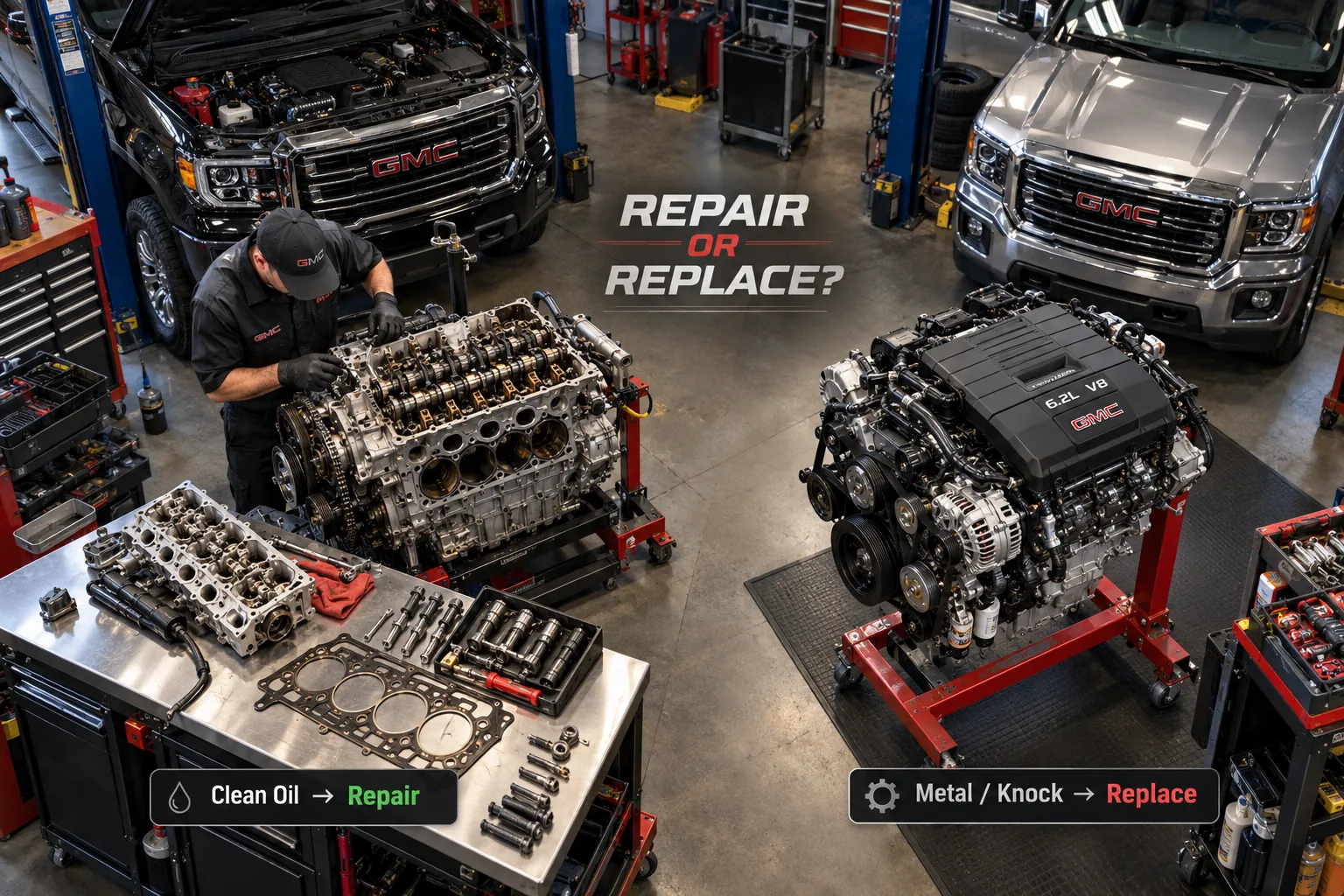
A top-end repair is usually enough when the oil and filter are free of metal, the camshaft lobes aren't badly worn and the bottom end runs quietly. Go for a full engine when there's metal in the oil, a knock from the bottom end or low oil pressure, or the truck is past about 180,000 miles.
A 5.3 with a collapsed lifter at 110,000 miles: if the bottom end is healthy, a lifter and cam job is often the better value. At that mileage, the rest of the engine usually has plenty of life left.
AFM/DFM delete trade-offs. A delete removes the part that failed, so the same problem shouldn't come back. The downsides are real, though:
- The engine computer has to be reprogrammed to stop it trying to shut off cylinders.
- Fuel economy typically drops by 1–2 mpg.
- Changing emissions-related equipment on a road vehicle can break federal and state emissions rules and cause inspection failures.
- Any warranty claim on a related part can be harder to win.
If you want the lowest risk, keep AFM/DFM and fit updated GM lifters. If you're out of warranty and want a simpler engine, a delete is worth discussing with your shop.
Replace, Rebuild or Swap: The Cheapest Option for Your Sierra
For most 5.3L Sierras, a used engine is the cheapest way back on the road. A rebuild only wins if you have a machinist you trust and plan to keep the truck for a long time. Here's how the options compare on the 5.3L.
Swapping to a different engine family, like a 6.2L into a truck built with a 5.3L, is a much bigger job. It usually needs a different transmission calibration, wiring changes and engine computer programming, and often costs more than replacing like for like.
Sierra Engine Replacement Labour Costs and Time off the Road
Labour typically makes up 30–45% of a used-engine job and 20–30% of a new-engine job. On a Sierra, the engine usually comes out the top with the cab left in place, which is quicker than many trucks, but the size of these V8s and all the wiring, cooling and intake parts that have to move across still add up.
The engine itself usually arrives in one to three days. The real wait is the shop's schedule, so ask when they can get your truck into a bay, not just how many hours the job takes. Also ask whether the quote includes flushing or replacing the oil cooler and its lines. Skipping that step is one of the most common reasons a replacement engine fails again: debris from the old engine sits in the cooler and gets pumped straight into the new one.
Used, Remanufactured or New: Three Routes Priced Side by Side
On a 5.3L Sierra, going used saves you roughly $2,500 up front compared with a reman. What the extra money buys is certainty: an engine with new lifters, bearings and seals, backed by a warranty measured in years. Here's the same 5.3L job priced three ways.
| 5.3L route | Used | Remanufactured | New GM |
|---|---|---|---|
| Engine price | $1,500–$3,500 | $4,000–$5,500 | $5,500–$7,500 |
| Labour (12–16 hrs) | $1,320–$2,880 | $1,320–$2,880 | $1,320–$2,880 |
| Gaskets, fluids, cooler flush | $400–$700 | $400–$700 | $400–$700 |
| Installed total | $3,200–$7,100 | $5,700–$9,100 | $7,200–$11,100 |
| Warranty | 90 days, parts only | ~3 years / 100,000 miles, often with labour | GM parts warranty; labour covered if a dealer installs it |
| Condition | 60,000–150,000 miles | New lifters, bearings, timing parts | Factory new |
| Lifter risk | Depends on the donor's history | Low, with updated lifters | Lowest |
A simple way to decide: if you'll sell the truck within two years, a good used engine is the smart buy. If you plan to tow with it and keep it past another 75,000 miles, the reman usually works out cheaper per mile.
Replacing The Engine Vs Selling the Truck: When Each Makes Sense
Sierras hold their value well, which tips the maths towards fixing them far more often than with a car. A good rule: replace the engine if the repaired truck will be worth at least $3,000 more than the job costs, and the transmission, frame and body are in good shape.
Worked example: 2018 Sierra 1500 SLE, 5.3L, 150,000 miles, collapsed lifter with metal in the oil.
Selling as-is gets you about $7,000 and leaves you shopping for another truck. Spending $5,000 on a used engine gives you an $18,000–$21,000 truck, roughly $6,000–$9,000 better off than selling, without taking on someone else's problems. Even the $8,000 reman comes out well ahead here, which is why a reman often makes sense on a Sierra in a way it rarely does on an older car.
The picture changes when the truck has other big problems. If the transmission is slipping, the frame is rusting or the truck needs both an engine and a transmission, selling as-is can be the smarter call.
Buying a Used Sierra Engine: 7 Things to Confirm First
A used engine is only a bargain if it's the right engine and it's healthy. Get clear answers to these before any money changes hands, and get them in writing.
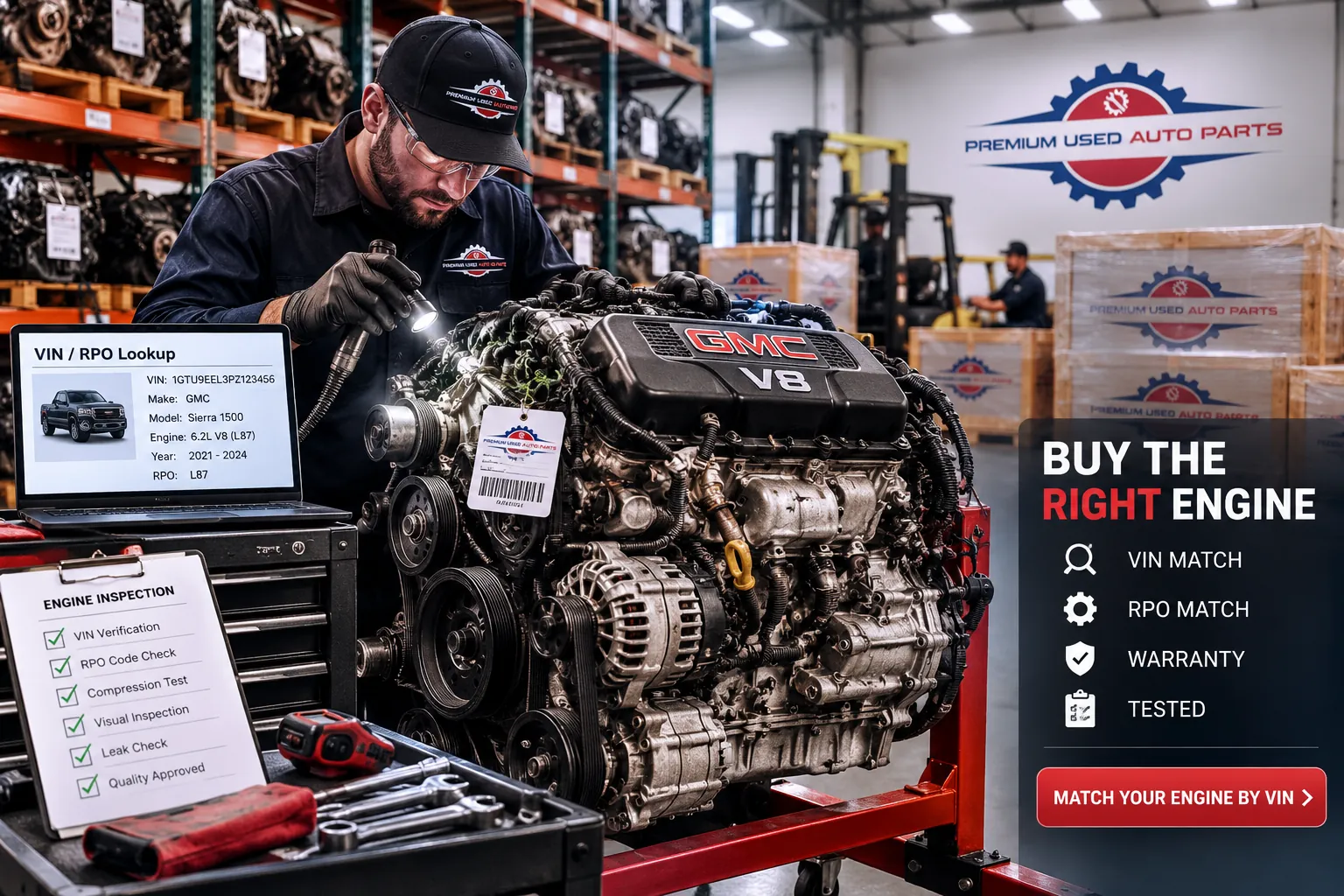
1. Match the Engine Code to Your RPO Label
The three-character code has to match: L84 for L84, L87 for L87. An L83 and an L84 are both 5.3L V8s, but they use different lifter systems, sensors and engine computer calibrations. Check 2WD or 4WD as well, since some mounts and accessories differ.
2. Verify the Mileage and Ask for Proof
Ask for the donor truck's VIN and a photo of its odometer. The VIN confirms the model year and lets you check the truck's history. For a 5.3L, try to stay under 120,000 miles.
3. Ask for a Compression Test or a Running Video
A good seller can show compression readings for every cylinder, ideally within about 10% of each other, or a video of the engine running before it was pulled. On a 5.3L or 6.2L, listen in that video for a lifter tick at idle.
4. Check What the Warranty Covers and for How Long
A 30-day, parts-only warranty is close to worthless once you've paid for labour. Hold out for 90 days and, before buying, review the used engine warranty terms so you know exactly what is covered if the replacement fails.
5. Know Whether It's a Long Block or a Complete Engine
A complete engine comes with the intake, injectors, sensors and wiring already fitted, which saves labour but hides more unknowns. A long block means moving your own parts across. Make sure every quote is for the same thing, or the prices won't compare.
6. Confirm the Shipping, Core and Return Terms
Shipping a V8 usually costs $150–$450. Some sellers also hold a core deposit until your old engine is returned. Find out up front who pays the return shipping if the engine turns out to be faulty.
7. Find Out Why the Donor Truck Was Scrapped
An engine from a truck that was rear-ended is about as good as it gets. One from a flood truck, a fire or a "ran when parked" listing is not. The donor VIN usually tells you which you're getting.
Check Whether a Used L87 Comes From Inside the Recall Window
If you're buying a used 6.2L L87, ask which truck it came from and whether that truck's recall 25V274 inspection was completed. Engines built outside the recall window are often priced at a premium, while engines from affected trucks may be discounted.
Frequently Asked Questions
The Bottom Line
Most Sierra owners pay $3,200–$7,100 for a used 5.3L. Before buying, check the L87 recall if you have the 6.2L, confirm the engine is truly finished rather than a lifter job, note your RPO code, and insist every quote includes the oil cooler. Ready to find the right replacement? Contact Premium Used Auto Parts and share your VIN for a matched GMC Sierra engine.

The Premium Used Auto Parts Editorial Team is backed by years of experience in the automotive parts industry and creates practical, research-driven content for vehicle owners, repair shops, and DIY enthusiasts across the USA. Our team combines real-world parts expertise with industry research to help drivers make informed decisions about OEM replacement parts, vehicle repairs, and maintenance. Every article is developed with a commitment to accuracy, transparency, and delivering reliable information that supports smarter vehicle ownership.