RAM 1500 Transmission Problems: Signs, Solutions & Replacement Guide
Table of Contents
10 ChaptersIntroduction
Your RAM 1500 probably won't break down on the side of the road to tell you there is an issue.
Transmission troubles start off so quietly most people don't notice. Now and then a transmission will send a heavy shift your way. One time, you experience a quick pause moment when you engage drive. You drive highway speeds and now your vehicle starts to shudder. Most people will just shrug this off until they can't anymore.
What's troubling isn't noticing the symptom. It's how much you will have to spend at the end of the day to get this fixed and still retain the functionality of this part.
This guide walks you through it: what the common RAM 1500 transmission problems actually point to, which transmission is in your truck, when repair makes more sense than replacement, and exactly how to verify fitment before you spend a dollar on a used unit.
What Do These RAM 1500 Transmission Symptoms Mean?
One weird shift on a cold morning isn't a diagnosis. A pattern is. Here's what to pay attention to:
Hard or Harsh Shifting
Your truck lurches into gear rather than smoothly. There are many reasons for this. It could be low fluid, worn valve body, worn solenoids, or even internal clutch wear. Harsh 3-4 and 4-5 shifts are known to occur in older RFE-family transmissions from a worn valve body.
Transmission Slipping
You press the gas pedal to get the engine to rev. The truck doesn't accelerate as hard as it should. This is usually from worn clutch packs, low line pressure, or a failing torque converter.
Delayed Engagement
The truck takes a second to engage when you put the truck into drive or reverse. Usually, it is from low fluid, internal leaks, or worn clutch application circuits.
Shudder or Vibrate
This is usually from the torque converter's lockup clutch. However, shudder on light throttle can be from many things. Vibrations in the driveline from U-joints, driveshafts, or even flexible motor mounts can feel the same as vibrations in your torque converter.
Strange Sounds, Smells, Leaks
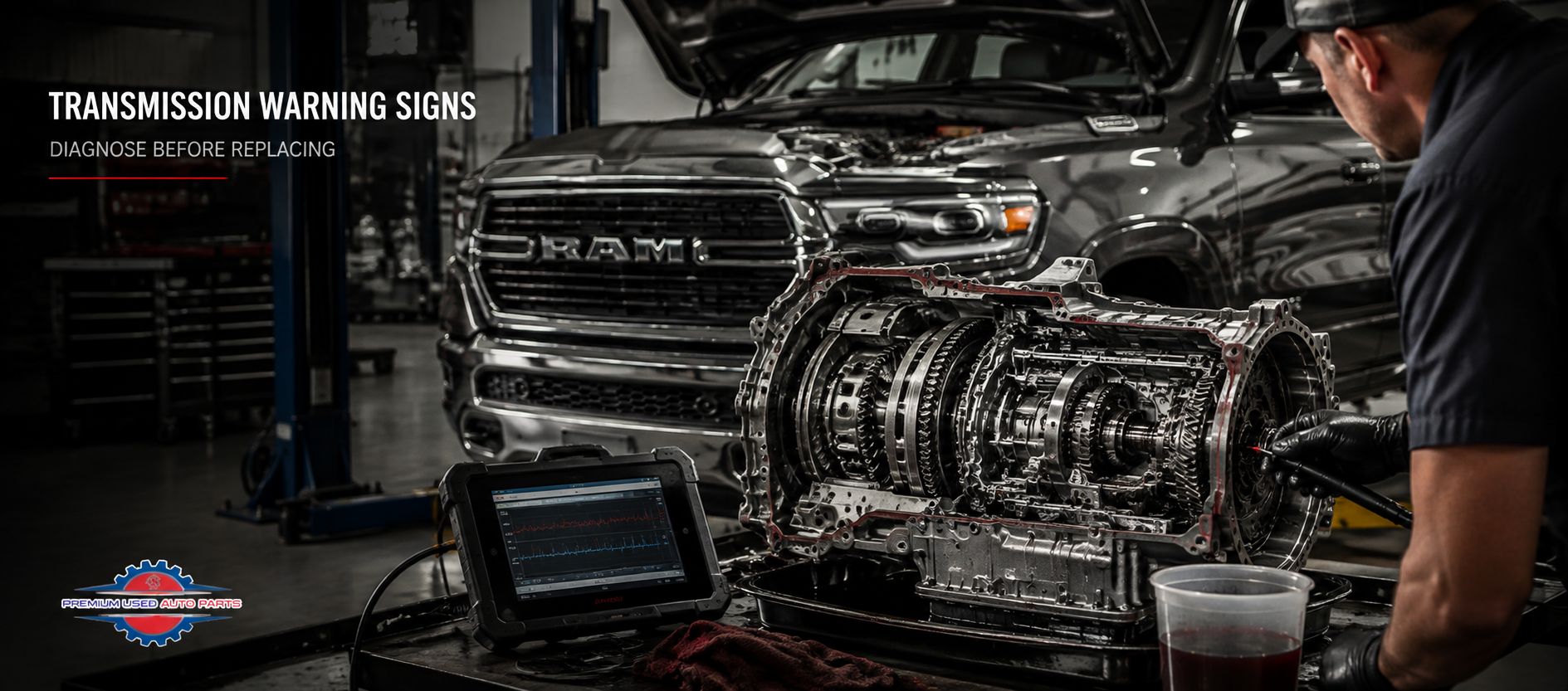
If you hear whining sounds and it increases at higher speeds, shifting may become harder, there's a burnt smell, and you may notice fluid leaking out on the ground. Burning fluids indicate the unit is running too hot which is the worst thing that can happen for machinery.
RAM 1500 Transmission Models by Year & Engine
This is where people get confused. The RAM 1500 uses different transmissions at different periods of time. Knowing your transmission makes a huge impact on how you find a replacement.
A quick note on transmissions that are not RAM 1500 units: the 68RFE and 66RFE belong to the 2500 and 3500 Heavy Duty trucks. If a listing offers you one of those for a 1500, something is wrong with the listing.
2019–2024 Classic vs. DT — The Mix-Up That Costs People Money
This one tends to shock buyers the most.
When RAM made the fifth-generation 1500 (DT) for 2019, they decided to keep selling the fourth generation model alongside the DT and the RAM 1500 Classic until 2024.
This means there are two completely different trucks with the same model year for 2019-2024.
For 2019, the DT was paired with the 8HP75 and the HEMI. The RAM 1500 Classic had the 65RFE, 8HP70 or 845RE, or 850RE.
The fastest way to identify them: the Classic has five lugs, and the DT has six lugs. This is pretty much the only way to differentiate the two models.
If you buy based on model year alone there's a strong possibility that the transmission you end with will never fit.
Repair, Rebuild, or Replace?
Once you know what's actually failing, the decision gets a lot clearer.
When a Repair Is Enough
A single serviceable component is all it takes to diagnose the problem and perform a repair on your truck. Cooler line leaks, contaminated fluids, a faulty speed sensor, or a leaking solenoid pack are all easy fixes. People replace entire transmissions at a several thousand dollar cost at the expense of a $200 repair part.
When Rebuilding Makes Sense
A rebuild should be considered if the internal components are worn out, but the case and valve body are intact. The worn components are replaced and everything is reconstructed. This can be a feasible option, however, this rebuild should be weighed against the cost of the replacement.
When Replacement Is the Only Option
If severe internal damage is evident, metal was present in the pan, multiple failures occurred after previous repairs or the rebuild estimate is not cost effective, a replacement is the best option.
Used OEM
A used OEM transmission can be used to keep the same truck configuration at a significant cost savings compared to buying a brand new unit. Since used and correct are not synonyms, here is where we start to talk about what is really important.
How to Verify Fitment Before You Buy
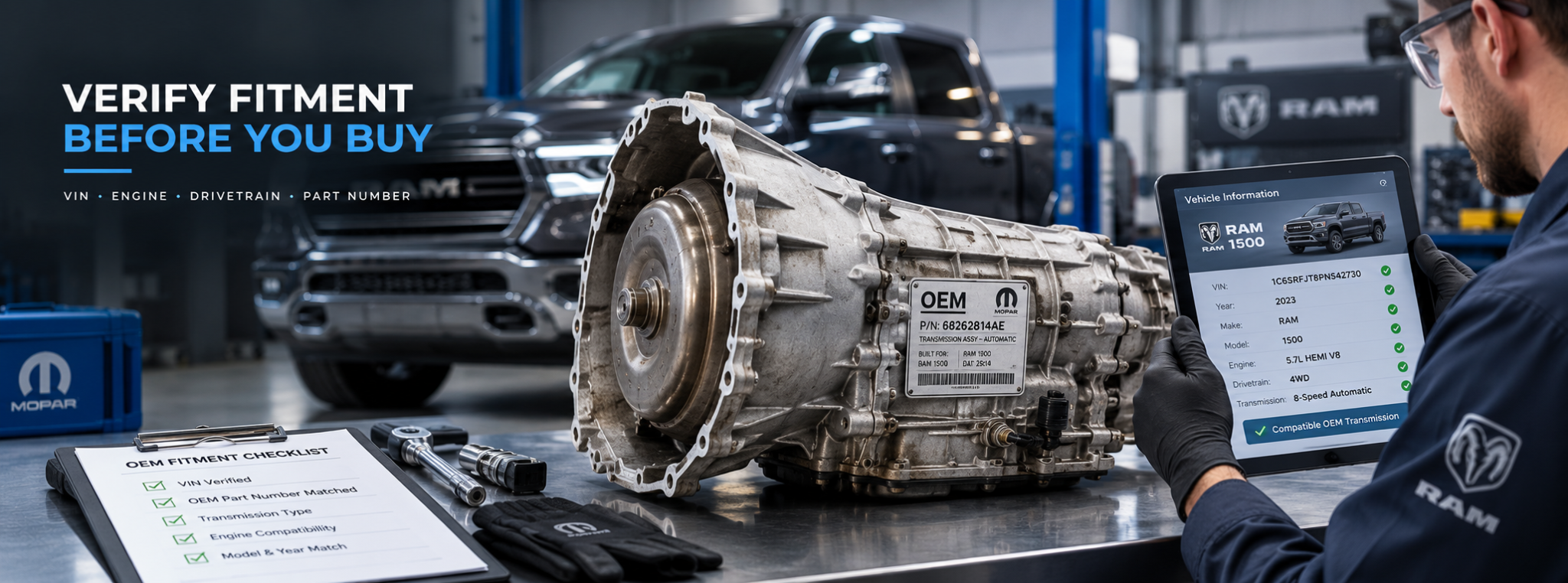
- Model year - Confirm the exact year, and whether it's a Classic or DT for 2019-2024
- Engine - 3.6L Pentastar, 5.7L HEMI, 3.0L EcoDiesel, and 6.2L all pair differently
- Drivetrain - 2WD and 4WD units differ; a 4WD transmission needs to accept a transfer case
- Transmission code - 545RFE, 65RFE, 8HP70, 8HP75, 845RE/850RE
- OEM part number - Check the tag on the transmission case itself
- VIN confirmation - Your 17-digit VIN ties all of the above together
That last step is the one that people skip and regret. A VIN-based lookup shows exactly how your own specific truck left the factory and is more reliable than trying to determine based on the year and model name.
Can RAM 1500 Transmissions Be Interchanged?
Never based on year alone.
Two RAM 1500s from the same model year can have different transmissions built to the engine, drivetrain, and Classic/DT configs. Before you assume anything swaps, check the transmission code and part number on your truck.
Buying a Used RAM 1500 Transmission — Checklist
Before you pay, get clear answers on all six:
- All components checked and confirmed - Year, engine, drivetrain, transmission, and VIN Models with similar technical specifications are eligible for the swap.
- Donor mileage - Ask about it, but don't use it as the only indicator of condition.
- Inspection details - Was the object/unit tested? Has the seller described the method of testing?
- Part number match - Compare this specific number against your unit/model number and not just pictures.
- Warranty - What is covered, length of coverage, and if there are any particular steps required for the installation.
- Policies - The seller has a track record and if they mention they have a return policy, they should outline the details. Clear product descriptions.
Where to Find a Used RAM 1500 Transmission
At Premium Used Auto Parts, we verify fit before we sell. Provide your VIN and year, engine, and drivetrain, and we will verify which transmission your truck was built with so we can find the correct unit to sell you.
Every transmission we sell has its condition, mileage, and warranty described, and is readable before you purchase. There are no unexpected surprises when you receive a transmission because you do not have to interpret a model name.
Still Have Questions? Here's What Owners Ask Most
Conclusion
You don't necessarily need a new transmission for your RAM 1500 if the problem is down to shifting issues. You will need to take it to a mechanic in order to know for sure what the actual problem is. Then weigh the cost and feasibility of repairs or rebuilds, depending on the actual problem.
When dealing with replacements, however, fitment is of primary concern. Confirm your year, engine, drivetrain, transmission code and part number. Verify all of these with your VIN. Do you need a used RAM 1500 transmission that actually fits your truck? Send us your VIN and we will verify fitment.

The Premium Used Auto Parts Editorial Team is backed by years of experience in the automotive parts industry and creates practical, research-driven content for vehicle owners, repair shops, and DIY enthusiasts across the USA. Our team combines real-world parts expertise with industry research to help drivers make informed decisions about OEM replacement parts, vehicle repairs, and maintenance. Every article is developed with a commitment to accuracy, transparency, and delivering reliable information that supports smarter vehicle ownership.